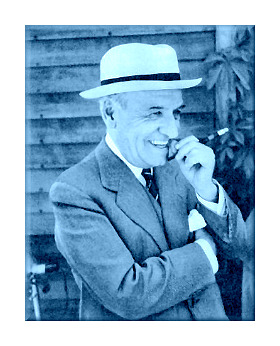
 “For a century and half the masses have claimed to be the whole of society. Stravinsky’s music or Pirandello’s drama have the sociological effect of compelling the people to recognize itself for what it is: a component among others of the sociological structure, inert matter of the historical process, a secondary factor in the cosmos of spiritual life. On the other hand, the new art also helps the elite to recognize themselves and one another in the drab mass of society and to learn their mission which consists in being few and holding their own against the many.” — Jose Ortega y Gasset, “The Dehumanization of Art,” 1925
Quote of the day
Beethoven’s First: Genius makes an early appearance
 Back in the late 20th century, when newspapers were still king, I wrote a series of nine essays on the Beethoven symphonies, one for each work. They appeared on successive Sundays in the Register, as lead up to a complete performance of The Nine in O.C., by John Eliot Gardiner and the Orchestre Revolutionaire et Romantique. My editor (Scott Duncan, a former music critic) and I cooked up the idea of the essays and the paper gave me lavish amounts of space in which to write them.
The essays never made it online (or if they did, they only lived there a short while) and have since languished deep within the Register‘s archives, from which I dug up the first one the other day and link to here: Naturally, it’s on Beethoven’s First Symphony.
Over the next couple of months, I intend to retrieve the other essays, post them on the newspaper’s website and link to them here. Once I have posted them all, I’ll make a page here and we’ll have an online guide to all nine symphonies.
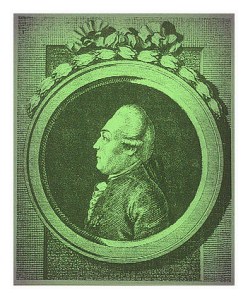
picture: baron van swieten, about whom you’ll learn a little more in my essay.
Alex Ross’s first record
I may have started something. Stranger things have happened.
At any rate, in his gracious post welcoming your favorite critic back to the blogosphere (or, as he spells it, błøǧösphère), Alex Ross (you know who he is) remembers his first record purchase, and, as it happens, it was a Bruckner symphony as well. Great minds, and all that.
He also still has the recording. See for yourself.
Related post: First record
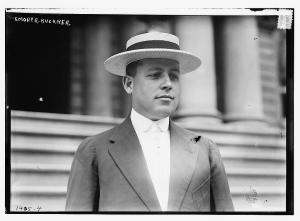
photo: emory bruckner, library of congress. I don’t know who he is but I liked the photo. His name might actually be emory buckner, not bruckner, since that’s what’s printed on the photo. (the catalog listing has him as “bruckner.”) click on for larger view.
Symphony of acrobats
My review: With the Pacific Symphony Saturday at Verizon, Cirque de la Symphonie demonstrated why it’s one of the most successful acts in the world of orchestral pops. The Orange County Register, July 18, 2010.
First record
 originally written for kusc’s blog in 2009
My memory is a little foggy on some of the details. I was in high school, already a burgeoning trombonist, and already getting in amongst my mother’s collection of classical LPs. At some point, though, I decided to buy one of my own and that ended up being a recording of Bruckner’s Fourth Symphony, with Herbert von Karajan conducting the Berlin Philharmonic. To the best of my recollection, chairman, that was my first classical record. At any rate, that’s my story and I’m sticking to it.
Why Bruckner’s Fourth? I had never even heard of the composer, let alone his music, until about a week before. I was taking private lessons with a trombone teacher at Cal State Long Beach and he had gotten me started on what would come to be my daily bread for the next decade or so: orchestral excerpts. In those days they came in books (probably still do), just the trombone parts to famous and not so famous orchestral pieces that had significant contributions from the lower brass: the Overture to “William Tell,” “Ride of the Valkyries,” Schumann’s Symphony No. 3, “Bolero,” etc. Thumbing through one of the volumes during a lesson, we came across Bruckner’s Fourth and I remember my teacher playing the opening theme — two quarter notes, followed by quarter-note triplets, a characteristic Bruckner rhythm — and I thought it sounded pretty interesting and my teacher said it was a good piece, with good trombone parts. That was enough for me. I wanted to hear it.
You know, for kids

Preview: Making a cirque out of a symphony. The Orange County Register, July 16, 2010.
Also:
Pacific Symphony to give free concerts in parks
Classical Life returns

Classical Life returns.
I’ve been blogging about classical music for nearly four and a half years for my employer, the Orange County Register. I am still employed as the classical music critic there, but the blog was recently mothballed, so I’ve decided to get my own.
(The L.A. Times covered the demise of my Register blog, and Iron Tongue of Midnight, Alex Ross and ARTicles also weighed in. And thanks to my readers for all the support they sent my way.)
I don’t quite know what shape this blog will take. Blogging for a newspaper has its own set of imperatives, many of which drove my thinking and writing there. Here, the rules are different, and I’m still learning what they are.
One thing I will do is provide links to my articles and reviews at the Register. I hope you’ll click on them (and read once you do) as faithfully as you have done in the past. My livelihood depends upon it.
But I don’t want this just to be a blog that links to my writing elsewhere. I want to provide original content as well, and will do so as often as time, energy and inspiration allow me to.
As always, your comments are welcome, even encouraged.
I’ll leave it there for now (I have to get to work). Stay thirsty, my friends.
10 ways not to clap after every single song at a Kathleen Battle recital
[From the archive. First posted on Feb. 18, 2010 on my blog at the Register.]
The following list is offered as a public service.
10. Don’t clap until Kathleen Battle commands you, by royal decree, to clap.
9. Buy two tickets for $250 each to the recital. Leave them in the back pocket of your jeans. Launder according to instructions.
8. You’re on your way to the concert when you realize that you left the back burner on, the one that smokes all the time. You turn around and go home and find your teenager having a wild party in your absence. Rather than get mad, you join him.
7. Wait until you hear “O mio babbino caro.”
6. Go to True Value Hardware. Buy a packet of 5-inch nails. Insert nails between each finger, with the sharp points facing the opposite palm. Attend recital as usual.
5. One word: Handcuffs!
4. Clap only when the “Applause” sign is lit up.
3. Clap only when Battle is singing.
2. Bring your cell phone to the concert. As the concert begins, call your health-care provider with a question about your coverage. Listen to your phone-tree options, press the one you want. Wait.
1. Order the chicken salad and hold the toast — between your knees!
15 records that went ahead and made my days
[From the archive. First posted March 20, 2009 on my blog at the Register.]
Bloggers give each other assignments. Alex Wellsung came up with the following, a kind of chain letter that asks blogger to:
“Think of 15 albums that had such a profound effect on you they changed your life or the way you looked at it. They sucked you in and took you over for days, weeks, months, years. These are the albums that you can use to identify time, places, people, emotions. These are the albums that no matter what they were thought of musically shaped your world. When you finish, tag 15 others, including me. Make sure you copy and paste this part so they know the drill. Get the idea now? Good. Tag, you’re it.”
Wellsung didn’t actually tag me, but I’m going to take the bait anyway. The following list is not the same as “my favorite” records. I’d say they were formative records for me; they changed the way I heard music in some way. Since I was a trombonist, and in orchestras from high school on, my list is heavy on orchestral repertoire. No apologies.
1. “Jumpin’ Jack Flash.” The Rolling Stones.
(First record that I ever bought, at Gillette Records in Riverside, CA. I was 8.)
2. “The White Album.” The Beatles.
(My older brother bought this one. Everything about it seemed mysterious and artsy to me, important and revolutionary. It gave me the idea that records could be more than just music.)
3. Stravinsky: “The Rite of Spring.” Artists and label unknown.
(I picked this out of my mother’s collection in my early teens, put on the headphones, and was transfixed.)
4. Glinka: Overture to “Ruslan und Ludmila.” New York Philharmonic, Leonard Bernstein.
(My Fountain Valley High School orchestra teacher Jean Clower slapped this on the gramophone one day for the entire ensemble to hear. We were playing the same, or trying to. I never imagined it could sound so cool.)
5. Bruckner: Symphony No. 4. Berlin Philharmonic, Herbert von Karajan.
(First classical LP that I ever bought. Orchestral sound of thrilling richness, space and nobility beyond description.)
6. “Switched on Bach.” Walter Carlos, Moog synthesizer.
(My first real introduction to the contrapuntal wonders of Bach, which Carlos’ orchestrations made explicit. It remains some of the best Bach on record.)
7. “Fear of Music.” Talking Heads.
(Art rock that rivaled classical music in ambition, method and impact.)
8. Schumann: Symphonies No. 1 and 4. London Symphony Orchestra, Josef Krips.
(This proved oddly mesmerizing for me in a way that expanded my limited classical music horizons. Schumann seemed “difficult” to me — and yet I liked it.)
9. Beethoven: Symphony No. 3, “Eroica.” Los Angeles Philharmonic, Carlo Maria Giulini.
(Giulini’s powerful reading, with my home band, is remarkable for its patient build-up and careful orchestral preparation — I felt that I was hearing the inner workings, the nuts and bolts, of a piece for the first time explicitly.)
10. Mozart: Symphonies Nos. 35 and 39. NDR Symphony, Pierre Monteux.
(Monteux was the first musician to show me that Mozart could sing, dance and smile. Heretofore, I had only heard Germans perform him.)
11. Xenakis: “Metastasis”; “Pithoprakta.” Orchestra National de L’office de Radio-diffusion Television Francaise, Maurice Le Roux.
(Atonal, avant-garde music made decipherable by its architectural patterns and cogent drama. A sound spectacle that didn’t have to “mean” anything at all.)
12. Bernd Alois Zimmermann: “Photoptosis”; “Tratto II.” Radio-Symphonie-Orchester, Berlin, Hans Zender. (Strange, otherworldly music. “Photoptosis” is a kind of surreal orchestral collage, with musical quotes, including from Beethoven’s 9th, embedded. “Tratto II” is the first electronic piece that I returned to again and again, a meditative dreamscape, complete with scuba diver breathing.)
13. Beethoven : Piano Sonata in D, Op. 10, No 3. Sviatoslav Richter, piano.
(My introduction to the wonders of the Beethoven piano sonata. We were analyzing this piece in college and Richter helped make it vividly clear to me.)
14. Bartok: String Quartets Nos. 3 and 4. Juilliard String Quartet, Columbia Masterworks M 31197. (Wow, what a record. Who knew string quartets could be this mean and vicious. I didn’t at the time. Still my favorite string quartet record.)
15. Shostakovich: Symphony No. 9. New York Philharmonic, Leonard Bernstein.
(Perhaps the funniest symphony ever written, a big raspberry in Stalin’s face. I used to have a couple of drinks and slap it on the record player. Bernstein and the New Yorkers have a jolly time with it.)
The world’s greatest orchestras according to Gramophone
[From the archive. First posted Nov. 27, 2008 on my blog at the Register (which has gone away).]
Gramophone magazine (which I once wrote an article for) has ranked the world’s 20 best orchestras.
First, here’s the list:
1 Royal Concertgebouw Orchestra
2 Berlin Philharmonic Orchestra
3 Vienna Philharmonic Orchestra
4 London Symphony Orchestra
5 Chicago Symphony Orchestra
6 Bavarian Radio Symphony
7 Cleveland Orchestra
8 Los Angeles Philharmonic
9 Budapest Festival Orchestra
10 Dresden Staatskapelle
11 Boston Symphony Orchestra
12 New York Philharmonic
13 San Francisco Symphony
14 Mariinsky Theatre Orchestra
15 Russian National Orchestra
16 Leningrad Philharmonic
17 Leipzig Gewandhaus Orchestra
18 Metropolitan Opera Orchestra
19 Saito Kinen Symphony Orchestra
20 Czech Philharmonic
Second, here’s how Gramophone came up with the list:
Ranking the heavy hitters is by no means an easy task, but Gramophone has manfully taken the job in hand. Our panel of leading music critics comprised: Rob Cowan, James Inverne, James Jolly (all from Gramophone, UK), Alex Ross (The New Yorker, US), Mark Swed (Los Angeles Times, US), Wilhelm Sinkovicz (Die Presse, Austria), Renaud Machart (Le Monde, France), Manuel Brug (Die Welt, Germany), Thiemo Wind (De Telegraaf, the Netherlands), Zhou Yingjuan (editor, Gramophone China) and Soyeon Nam (editor, Gramophone Korea).
Thirdly, since a couple of you sent me the link to the story, you must be wondering what I think (even though Gramophone didn’t). Well, I take all such lists with an entire shaker of salt and I also am not that interested in them. The list does name many of the world’s best orchestras (the Philadelphia Orchestra is left off for some reason, though). But to come up with an actual order for them is a fool’s game: like ranking actors. Who was better, Henry Fonda or James Stewart? James Cagney or Humphrey Bogart?
At any rate, orchestras, no matter what their rank, are only as interesting as the conductors who lead them. The New York Philharmonic, for instance, is by some distance a better orchestra (technically) than the Los Angeles Philharmonic, but Salonen makes the latter more interesting and satisfying to listen to. But conductors aren’t mentioned in the list.
Again, technically speaking, the Leningrad Philharmonic (which if I’m not mistaken, has been renamed the St. Petersburg Philharmonic) is by far the superior to the Mariinsky Theatre Orchestra (aka the Kirov).
If conductors do figure (as they must have, in the L.A. ranking), I think you’d have to consider the Cincinnati Symphony (with Paavo Jarvi), the Royal Philharmonic (with Daniele Gatti), the Philharmonia (with Salonen) and, quite possibly, the London Philharmonic (with Vladimir Jurowski) for ranking. Also, I’d say the State of Mexico Symphony Orchestra (not on the list) is way better than the Czech Philharmonic (at 20), both of which I’ve heard in the last 12 months. And the Cleveland Orchestra is pretty booooring under Franz Welser-Most.
Anyway, whatever.
Support Classical Life

Classical Life

 Classical Life