
Percy Grainger, center, with saxophone. No photo date, but Grainger was a bandsman in the Coast Artillery Corps of the U.S. Army 1917-18. Click on for larger view. Library of Congress.
Percy Grainger, center, with saxophone. No photo date, but Grainger was a bandsman in the Coast Artillery Corps of the U.S. Army 1917-18. Click on for larger view. Library of Congress.
An excerpt for Khachaturian’s Symphony No. 3, performed by the Chicago Symphony Orchestra conducted by Leopold Stokowski. Just the messenger. In response to Alex Ross.

In today’s Orange County Register online, I write about the 31st season of the Baroque Music Festival, Corona del Mar, which almost didn’t happen. Click here to read my story.
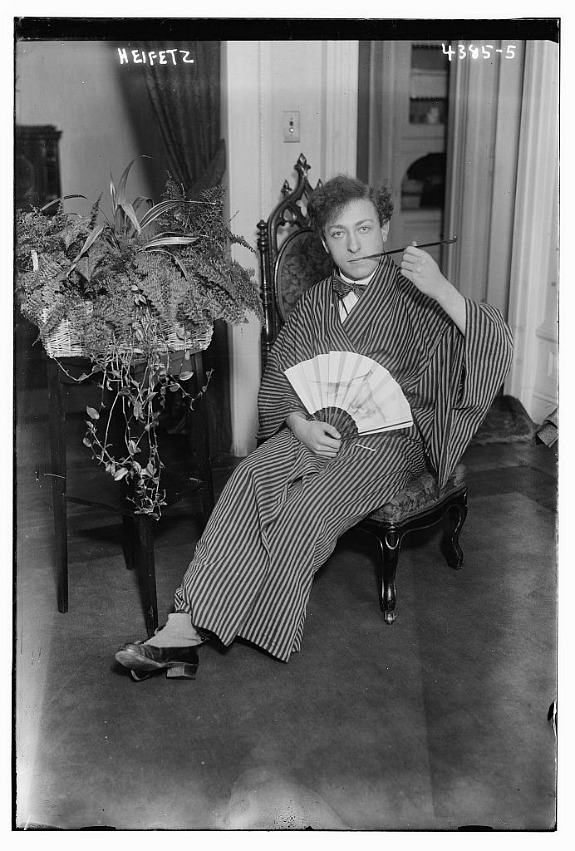
Jascha Heifetz. No date. Library of Congress.

John Philip Sousa and Camille Saint-Saëns, c.1915. Library of Congress.
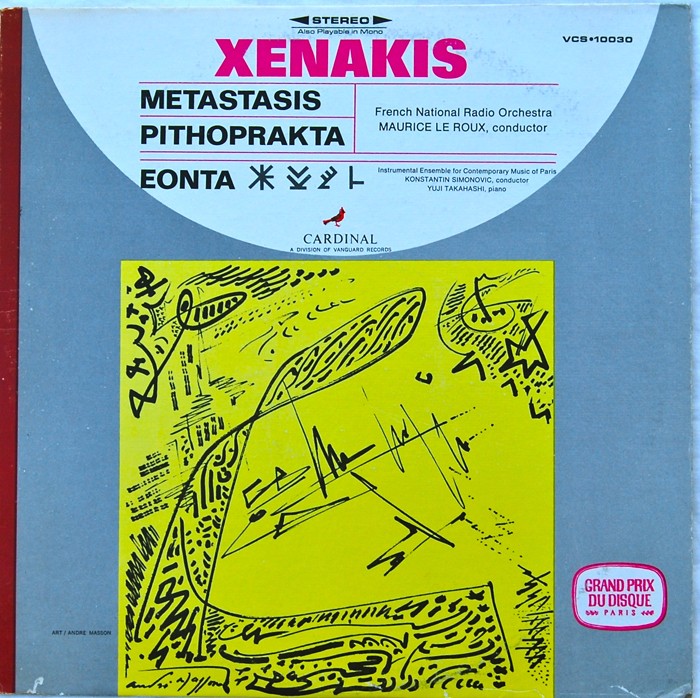
First published in 2009 on that old blog of mine and popular in the day.
Bloggers give each other assignments. Alex Baker came up with the following, a kind of chain letter that asks blogger to:
“Think of 15 albums that had such a profound effect on you they changed your life or the way you looked at it. They sucked you in and took you over for days, weeks, months, years. These are the albums that you can use to identify time, places, people, emotions. These are the albums that no matter what they were thought of musically shaped your world. When you finish, tag 15 others, including me. Make sure you copy and paste this part so they know the drill. Get the idea now? Good. Tag, you’re it.”
Wellsung didn’t actually tag me, but I’m going to take the bait anyway. The following list is not the same as “my favorite” records. I’d say they were formative records for me; they changed the way I heard music in some way. Since I was a trombonist, and in orchestras from high school on, my list is heavy on orchestral repertoire. No apologies.
1. “Jumpin’ Jack Flash.” The Rolling Stones.
(First record that I ever bought, at Gillette Records in Riverside, CA. I was 8.)
2. “The White Album.” The Beatles.
(My older brother bought this one. Everything about it seemed mysterious and artsy to me, important and revolutionary. It gave me the idea that records could be more than just music.)
Deutsche Grammophon is finally getting around to releasing a boxed set of the recordings it made with Carlo Maria Giulini and the Chicago Symphony. The 5-CD package with the lame cover (above) is a follow-up to a previous release the company made of the conductor’s recordings with the L.A. Philharmonic. It will be released on June 21 to an adoring public, which will no doubt utter a gigantic ‘huzzah’ and send it to the top of the bestseller lists.
But seriously, we’re all Giulini fans here. The track listings are not yet available online, but if DG includes the entirety of its recordings with the maestro and the Chicagoans the set will include.
1. Mahler’s Symphony No. 9.
2. Britten’s Serenade for Tenor, Horn and Strings (with Robert Tear and Dale Clevenger).
3. Schubert’s Symphonies No. 4, 8 and 9.
4. Dvorak’s Symphonies 8 and 9.
5. Mussorgsky’s “Pictures at an Exhibition”.
6. Prokofiev’s “Classical” Symphony.
I’ve not heard all of these recordings. But those I have are choice. The Mahler 9 (a Grammy winner) in particular is fearsome, and belongs in every collection. Giulini, at least at this stage of his career (the 1970s), recorded only music he felt deeply about and in which he had something special to say.
By the way, the Chicago Symphony has a free podcast of Giulini recordings made with the orchestra, including pieces by Prokofiev, Stravinsky, Dvorak and Schubert. Click here.
related posts: 10 Giulini recordings
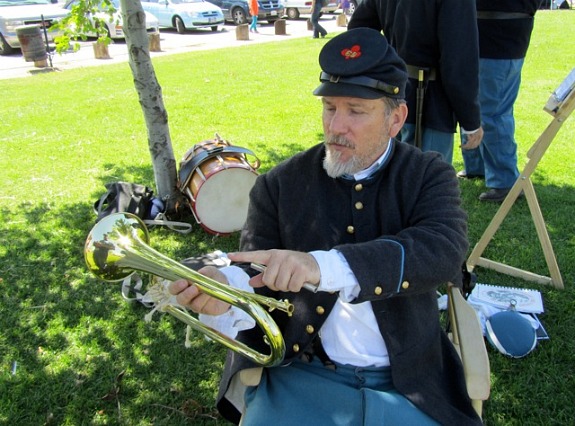
My wife and son managed to drag me to a Civil War reenactment Saturday. I had never been to one (neither had they) and I said to myself ‘Why the hell not?’ It might not beat lying around on the couch but at least I’d be with my family. The event was called ‘The Battle of Costa Mesa.’ It was quite the scene when we got there, both sides camping in the park in authentic fashion, with period tents and gear. Shortly after arriving, we came upon a group of Civil War musicians, parked in the shade of a tree. I approached them, curious to find out more. Bruce (above), the leader of the group, proudly showed me his French reproduction of a period bugle.
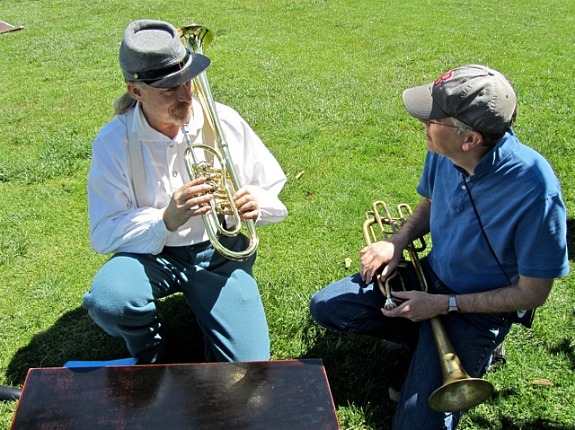
These guys are serious. This member of the band is showing me his brand new reproduction of a Civil War era rotary valve brass instrument. He paid a maker in the L.A. area thousands of dollars to make it for him. I’m holding a tenor horn, made by another member of the band. Both of these horns are held on the shoulder, with the bells pointed backwards. The regimental bands of the era, it was explained to me, marched in front of the troops, thus the direction of the bells.

In today’s Orange County Register online, I review the local premiere of David Lang’s Pulitzer Prize-winning ‘Little Match Girl Passion.’ Here’s the lead.
***
The Pacific Chorale’s latest concert, conducted by John Alexander on Sunday afternoon in Segerstrom Concert Hall, was an unusually serious one. Its purpose was none other than to raise awareness of the problem of child abuse, and not just anywhere, but here in Orange County.
April is National Child Abuse and Neglect Prevention Month. Upon entering the hall, listeners were given blue ribbon lapel pins, a symbol of the cause. Before the concert began, Kelly Ruggirello, the Chorale’s president, announced that 40,000 cases of child abuse were reported in the county in 2008. Representatives from 14 organizations that work here to prevent child abuse were asked to stand and accept the audience’s gratitude.
Click here to read the whole thing.
photo: stan sholik
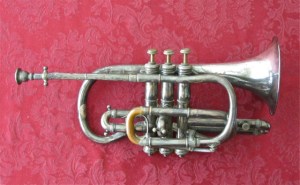
Here’s a photo of an old cornet that I normally have hanging on the wall in my study. (Click on the photos for larger views.) I got it at a garage sale I think. It was so long ago I don’t really remember. It’s a scrap heap really — the valves are in really bad shape and the instrument leaks air so that when you blow into it, the sound doesn’t even seem to make it all the way to the bell — but it looks nice on the wall. I hardly paid anything for it.
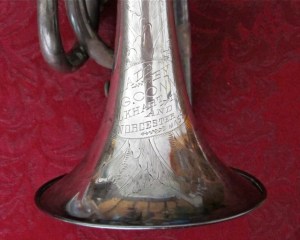
Here’s a photo of the bell. I polished it off so you could see the etching on it. It says “C.G. CONN ELKHART IND AND WORCESTER MASS.”

Here’s the serial number, stamped on the second valve. It looks like the numbers were stamped individually. The serial number dates the cornet to 1887.
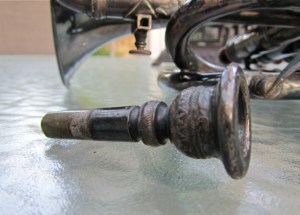
The elaborately engraved mouthpiece. It also has the words “Levy Model” on it. Jules Levy was one of the 19th century’s greatest cornet virtuosos. He also promoted Conn cornets. I found a newer Levy Model mouthpiece for sale on e-Bay for $75.
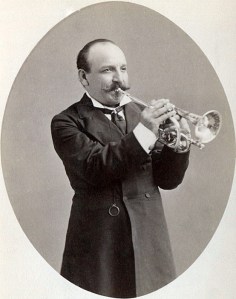
A photo of Jules Levy in the 1880s. It looks to me as if he’s playing the same model Conn cornet that I have, or very close.
Here’s a recording of Levy playing the cornet in 1903, the year he died. He’s performing a song called “My Own Make Polka,” which he also composed. He was a triple-tonguing whiz.


 Classical Life