New Giulini reissue on the way

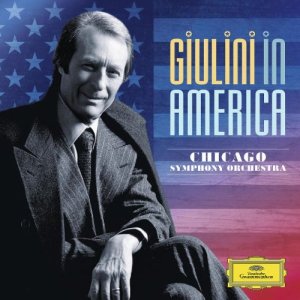
Deutsche Grammophon is finally getting around to releasing a boxed set of the recordings it made with Carlo Maria Giulini and the Chicago Symphony.  The 5-CD package with the lame cover (above) is a follow-up to a previous release the company made of the conductor’s recordings with the L.A. Philharmonic. It will be released on June 21 to an adoring public, which will no doubt utter a gigantic ‘huzzah’ and send it to the top of the bestseller lists.

But seriously, we’re all Giulini fans here. The track listings are not yet available online, but if DG includes the entirety of its recordings with the maestro and the Chicagoans the set will include.

1. Mahler’s Symphony No. 9.

2. Britten’s Serenade for Tenor, Horn and Strings (with Robert Tear and Dale Clevenger).

3. Schubert’s Symphonies No. 4, 8 and 9.

4. Dvorak’s Symphonies 8 and 9.

5. Mussorgsky’s “Pictures at an Exhibition”.

6. Prokofiev’s “Classical” Symphony.

I’ve not heard all of these recordings. But those I have are choice. The Mahler 9 (a Grammy winner) in particular is fearsome, and belongs in every collection. Giulini, at least at this stage of his career (the 1970s), recorded only music he felt deeply about and in which he had something special to say.

By the way, the Chicago Symphony has a free podcast of Giulini recordings made with the orchestra, including pieces by Prokofiev, Stravinsky, Dvorak and Schubert. Click here.

related posts: 10 Giulini recordings
‘Serving Genius: Carlo Maria Giulini’

Giulini remembered (interview)

Post No. 140, in which I become a Civil War reenactor

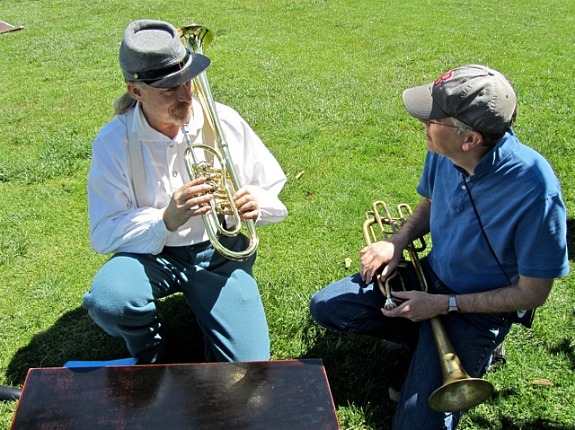
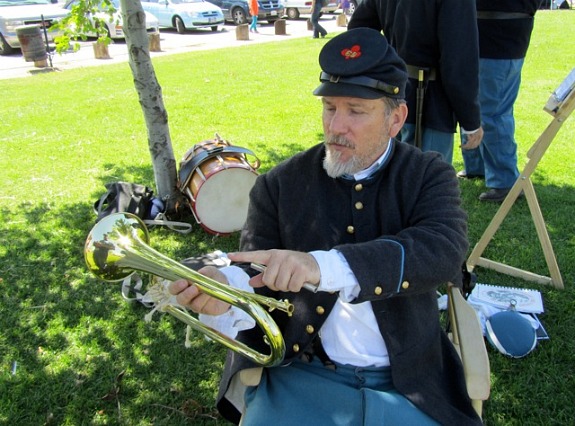
My wife and son managed to drag me to a Civil War reenactment Saturday. I had never been to one (neither had they) and I said to myself ‘Why the hell not?’ It might not beat lying around on the couch but at least I’d be with my family. The event was called ‘The Battle of Costa Mesa.’ It was quite the scene when we got there, both sides camping in the park in authentic fashion, with period tents and gear. Shortly after arriving, we came upon a group of Civil War musicians, parked in the shade of a tree. I approached them, curious to find out more. Bruce (above), the leader of the group, proudly showed me his French reproduction of a period bugle.

These guys are serious. This member of the band is showing me his brand new reproduction of a Civil War era rotary valve brass instrument. He paid a maker in the L.A. area thousands of dollars to make it for him. I’m holding a tenor horn, made by another member of the band. Both of these horns are held on the shoulder, with the bells pointed backwards. The regimental bands of the era, it was explained to me, marched in front of the troops, thus the direction of the bells.

Continue reading Post No. 140 …

Read more…

Pacific Chorale performs David Lang’s ‘Little Match Girl Passion’

In today’s Orange County Register online, I review the local premiere of David Lang’s Pulitzer Prize-winning ‘Little Match Girl Passion.’ Here’s the lead.

***

The Pacific Chorale’s latest concert, conducted by John Alexander on Sunday afternoon in Segerstrom Concert Hall, was an unusually serious one. Its purpose was none other than to raise awareness of the problem of child abuse, and not just anywhere, but here in Orange County.

April is National Child Abuse and Neglect Prevention Month. Upon entering the hall, listeners were given blue ribbon lapel pins, a symbol of the cause. Before the concert began, Kelly Ruggirello, the Chorale’s president, announced that 40,000 cases of child abuse were reported in the county in 2008. Representatives from 14 organizations that work here to prevent child abuse were asked to stand and accept the audience’s gratitude.

Click here to read the whole thing.

photo: stan sholik

From the archives: A cornet from 1887

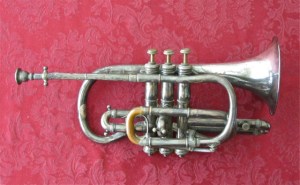
Here’s a photo of an old cornet that I normally have hanging on the wall in my study. (Click on the photos for larger views.) I got it at a garage sale I think. It was so long ago I don’t really remember. It’s a scrap heap really — the valves are in really bad shape and the instrument leaks air so that when you blow into it, the sound doesn’t even seem to make it all the way to the bell — but it looks nice on the wall. I hardly paid anything for it.

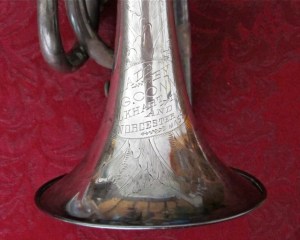
Here’s a photo of the bell. I polished it off so you could see the etching on it. It says “C.G. CONN ELKHART IND AND WORCESTER MASS.”

Here’s the serial number, stamped on the second valve. It looks like the numbers were stamped individually. The serial number dates the cornet to 1887.

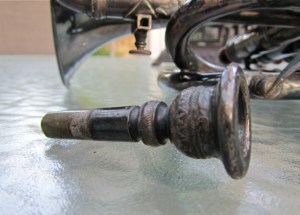
The elaborately engraved mouthpiece. It also has the words “Levy Model” on it. Jules Levy was one of the 19th century’s greatest cornet virtuosos. He also promoted Conn cornets. I found a newer Levy Model mouthpiece for sale on e-Bay for $75.

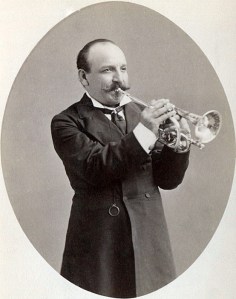
A photo of Jules Levy in the 1880s. It looks to me as if he’s playing the same model Conn cornet that I have, or very close.

Here’s a recording of Levy playing the cornet in 1903, the year he died. He’s performing a song called “My Own Make Polka,” which he also composed. He was a triple-tonguing whiz.

Choosing a violin III: The labels

Here’s the label inside my son’s new violin. We’ve been thinking that this is not a label that someone would fake, because Taningard is not well enough known. The specs of this violin all point to it being an 18th century violin — for one thing, we’ve found that the wood is only 2 millimeters thick.

Bonus: The photo on the right is of the c. 1850 bridge. It says “Aubert A Mirecourt France.” We’re told that this is a primo bridge. Our luthier, Stephen Davy, has laid in a supply of them, in case this one ever cracks. Not sure if we’d take him up on the offer, because it’s an expensive bridge (as far as bridges go).

Click on the thumbnails for larger views.

related posts: Choosing a violin

Choosing a violin II: Finding ‘The One’

Choosing a violin II: Finding ‘The One’

The phone on my desk at work rang around noon Monday. I sort of figured it was the wife on the line and it turned out I was right. I didn’t know that she would be so excited, though. Wife, son and violin teacher had made a visit to Stephen Davy’s violin shop in Laguna Niguel, which doubles as his house, in the morning. Their mission: To try out more violins. My son is in the market for his first full-size violin and his teacher, Alexander Shipitsyn,  is determined that he get a good one; his grandparents think it’s a grand idea as well and are chipping in.

I had expected this to happen, me being a know-it-all and such, though I didn’t know it would happen so soon. They had found “The One” — the violin that stood apart above all others, the clear winner, the end of our quest. My wife said that there was no question. This one was the best. The boy got on the phone and you should have heard how excited he was. He knew it too.

It turns out that the violin was one of Mr. Davy’s favorites and he had owned it for 30 years. He handed it to my son as the first of several instruments to try out. My wife said it got very quiet in the room when the boy did so. I don’t know if a choir of angels hymned along and the skies parted because I wasn’t there.

The violin’s provenance is not quite in order, which hurts its sale value but not its sound. The following is what we think it is, but I don’t believe we can prove it. It’s an 18th century Italian violin, made in Rome by one Giovanni Giorgio Taningard. The date on the label inside says “Fecit Romae Anno 1748.” (Labels can’t always be trusted, though.) There’s not a whole lot of information online about Taningard; even his dates are uncertain. One source says that he might have worked with or for David Tecchler (1666-  died after 1743), described in Bachmann’s “An Encyclopedia of the Violin” as “the most important violin maker of Rome.”

Read more…

Daniel Catán, composer of ‘Il Postino,’ is dead

The Los Angeles Times is reporting that composer Daniel Catán died in his sleep Sunday in Austin, Texas. He was 62 and apparently not ill. Wikipedia is saying that he died April 8.

I spoke to Catán a few times, in person and on the phone, and as recently as last September. He was a very nice man, intelligent, modest and personable. I genuinely liked him. He was also a gifted and interesting composer, a student of Milton Babbitt who had found his own way to a conservative, lyrical, Impressionistic style, seasoned with his Latin heritage.

His “Il Postino,” which Los Angeles Opera premiered last fall, with Domingo in the title role, is a gem, and I think it will be performed often in the future. Catán also wrote a terrific orchestral piece for the Pacific Symphony a few seasons ago.

When I spoke to him last, he was very excited about his next project, an opera based on the Frank Capra classic “Meet John Doe.” He was definitely a bright light in contemporary opera.

Choosing a violin

The time has come. My son is growing like a weed and his violin teacher says he needs a full-size violin, a good one. The grandparents are willing — eager, in fact — to chip in.

And so I find myself in Foster’s Violin Shop, “Makers, Dealers and Restorers of Fine Violins,”  in Orange during my lunch hour on Friday. The shop is a house, actually, circa 1920, on a residential street in the old part of town. My wife and son, toting his current violin, meet me there. You walk in the place and are surrounded by wood, from floor to ceiling, string instruments everywhere. To the left is what must be the dining room, only it’s Roger Foster’s work room, a giant table covered with the tools of his trade and a bird in a cage its most noticeable features.

An assistant greets us at the front desk, and asks our mission. Her next question is necessary — what price range are we looking for? My wife’s answer is enough to make anyone nervous, especially me. The assistant doesn’t bat an eye, though. In the big scheme of violins, the number we quoted her is no big deal.

Read more…

Upcoming classical concerts in Orange County

Click here to see a list of five classical concerts coming up in Orange County in the days ahead.

photo: the flanzaley string quartet, library of congress

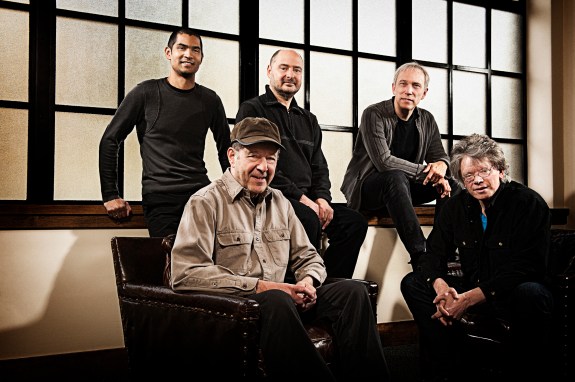
Kronos Quartet premieres 9/11 work by Steve Reich

In today’s Orange County Register online, I review the Kronos Quartet’s performance of a new work written for the group by Steve Reich. Here’s an excerpt.

***

I saw young people – an indication I was in the right place. The Kronos Quartet was in town and its hearty band of listeners had showed up in their usual numbers. The group is pushing 40, but its fans don’t age.

One might say that the Kronos – David Harrington and John Sherba, violins; Hank Dutt, viola; and Jeffrey Zeigler, cello – sounded rejuvenated Wednesday night in Segerstrom Concert Hall, except that rejuvenation is kind of their thing. Their mission has long been to perform the newest of the new. The ink was barely dry on the scores they played Wednesday; and all of the pieces had been composed especially for these players.

***

Click here to read the whole thing, or pick up a copy of Friday’s Register.

photo: jay blakesberg