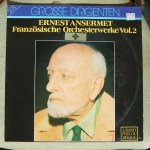
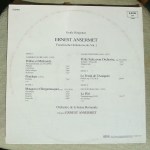
I’ve been given access to the record collection of The Most Interesting Man in the World. He allowed me to sample this one (see photos, click for larger views) and it was amazing. Wonder why we never hear this repertoire in concert.
For its diehard fans, a performance by the Alvin Ailey American Dance Theater (at Segerstrom Hall through Sunday) is a spiritual experience, with Ailey’s masterpiece “Revelations” the defining “prayer” of every show.
I can’t say I fall into that camp. But as “Revelations” began Tuesday night, the words of one particular spiritual — “There is trouble all over this world” — and the dancers’ emotional depictions of human frailty and burden did cause a shiver. In these times, who wouldn’t agree with that?
This Costa Mesa engagement comes during a significant transition period. Ailey artistic director Judith Jamison, one of the late choreographer’s leading muses and then his hand-picked successor, stepped down last July. She had been one of the dance field’s most successful directors. In partnership with executive director Sharon Luckman, she lifted the troupe to financial security, gave it a multi-million home in midtown Manhattan and raised the dancers’ artistic standards to new heights.
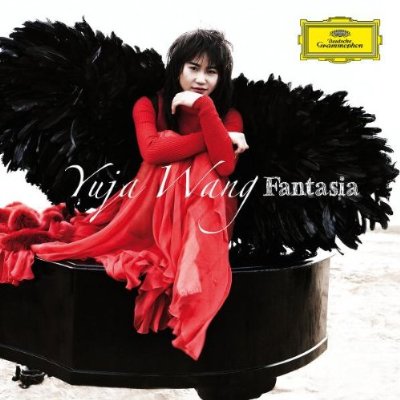
Here’s the cover of Yuja Wang’s latest CD. It will be released on April 10th.
I like the track list, though:
Sergei Rachmaninov (1873–1943)
1. Étude-tableau in A minor op. 39 no. 6
2. Étude-tableau in A minor op. 39 no. 4
3. Élégie in E flat minor op. 3 no. 1
4. Étude-tableau in E flat minor op. 39 no. 5 Domenico Scarlatti (1685–1757)
5. Sonata in G major K. 455 Christoph Willibald Gluck (1714–1787)
arr. Giovanni Sgambati (1841–1914)
6. Mélodie de Gluck, Melody from Gluck’s Orfeo ed Euridice Isaac Albéniz (1860–1909)
7. Triana, from Iberia, Book II Georges Bizet (1838–1875)/Vladimir Horowitz (1903–1989)
8. Variations on a Theme from Carmen
(Gypsy Song, Act II) Franz Schubert (1797–1828)/arr. Franz Liszt (1811–1886)
9. Gretchen am Spinnrade D118 Johann Strauss (1825–1899)/arr. György Cziffra (1921–1994)
10. Tritsch-Tratsch-Polka op. 214 Frédéric Chopin (1810–1849)
11. Valse in C sharp minor op. 64 no. 2 Paul Dukas (1865–1935)/arr. Victor Staub (1872–1953)
12. L’Apprenti sorcier Alexander Scriabin (1872–1915)
13. Prélude in B major op. 11 no. 11
14. Prélude in B minor op. 13 no. 6
15. Prélude in G sharp minor op. 11 no. 12
16. Étude in G sharp minor op. 8 no. 9
17. Poème in F sharp major op. 32 no. 1 Camille Saint-Saëns (1835–1921)
arr. Franz Liszt/Vladimir Horowitz
18. Danse macabre op. 40
In today’s Orange County Register online, I review last night’s Pacific Symphony concert, with conductor Michael Stern, pianist Joyce Yang and a certain overstuffed piano concerto.
Carlos Kleiber conducts the Vienna Philharmonic (sorry, Lisa) in “Die Libelle” (The Drangonfly), a polka mazur, by Johann Josef Strauss. I’ve been waiting to share this with you. Watch it now before they take the video down.
In today’s Orange County Register online, I review last night’s Pacific Symphony concert in which the orchestra performed two new works by Michael Daugherty and other hits. Lame or inspired?
I’ve been mulling over the following program in my spare thinking time the last couple of weeks. The Pacific Symphony performs it tomorrow through Saturday. I can’t make up my mind if it’s inspired, or lame. I suppose it’s somewhere in between. Here it is:
Daugherty: The Gospel According to Sister Aimee (2012) for Organ, Brass and Percussion (World premiere) Daugherty: Radio City (2011) Symphonic Fantasy on Arturo Toscanini and the NBC Symphony Orchestra in America (American premiere) Barber: Adagio for Strings Tchaikovsky: Violin Concerto
On the one hand, two pieces by Daugherty is too much. On the other, it’s nice to hear some new music. (BTW, I think Daugherty tries too hard with his titles.)
The order of the concert has changed. Previously the Barber came between the two Daugherty pieces. At any rate, the Barber and the Tchaikovsky are clearly on the program as sugar to make the medicine go down, or at least as names that will help sell tickets. The concerts are being marketed on the basis of the Tchaikovsky concerto, so I’m sure there will be a lot of audience members there who will be terrorized (if that’s the right word) by the Daugherty pieces. Not that he’s so wild. He’s kind of a populist, in fact.
In today’s Orange County Register online, I review last night’s performance by Riccardo Muti and the Chicago Symphony in Segerstrom Concert Hall. This review will not appear in print.





 Classical Life