
I’m back.
I thought I’d get started by posting a link to a Sunday essay I wrote back in May that got a lot of comment. It was behind the paywall then; it’s free now.
Talking to the (classical) stars. Orange County Register, May 16, 2013.
I’m back.
I thought I’d get started by posting a link to a Sunday essay I wrote back in May that got a lot of comment. It was behind the paywall then; it’s free now.
Talking to the (classical) stars. Orange County Register, May 16, 2013.
 After 90 days behind paywall bars, articles on ocregister.com are set free. Here are a few more of mine from May, for those who are still interested. You may read them gratis.
Review: Paul Jacobs plays recital of French organ music. May 6, 2013.
Review: ‘Singin’ in the Rain’ given concert premiere. May 10, 2013.
Review: Long Beach Opera performs ‘Van Gogh’ and ‘Tell-Tale Heart.’ May 12, 2013.

Please visit the blogs in the blogroll. I’ll be back in a bit.
After 90 days behind paywall bars, articles on ocregister.com are set free. Here are a couple more of mine from May, for those who are still interested. You may read them gratis.
Lights, camera, orchestra (preview/interview on the premiere of ‘Singin’ in the Rain’ in concert). May 2, 2013.
Conductor Aziz Shokhakimov debuts with Pacific Symphony. May 3, 2013.
From the archives: Classical stars on the Hollywood Walk of Fame
I see that it has been a year since I have mentioned the topic of summer reading, specifically mine.
Last time, I said something or other about the classification seeming rather nonsensical to me, since I don’t read any differently in the summer than I do in other seasons, and I doubt that most readers do. At any rate, here are some thoughts on what I’ve been reading since the weather got warm.
“Charles Jessold, Considered as a Murderer” by Wesley Stace is an astonishingly learned and lively novel set in the world of classical music.  The narrator is a music critic! Jessold is a hugely talented English composer of the early 20th century whose life runs, or seems to run, parallel with that of the great Renaissance composer and murderer Carlo Gesualdo (note the similarity in names). Stace’s scholarship in this novel is very impressive (check out his acknowledgments at the end). It turns out that Stace is merely the pen name for musician John Wesley Harding. His novelistic style reminds me most of Julian Barnes. There are plenty of plot twists in this book.
Speaking of music critics, I also read (before the summer solstice, full disclosure) volume three of “Music in London,” which collects the weekly reviews of Bernard Shaw in the early 1890s. Holy crap this guy could write! One suspects that many of his judgments are off and that, indeed, he’s making up stuff, but it really doesn’t matter at this date. I’ve read plenty of Shaw’s music criticism before — including “The Perfect Wagnerite,” the best introduction to the “Ring” cycle that I know of — but selections do him no justice. To read his weekly columns in full, laid end to end in chronological order, is to be awestruck as well as laugh-out-loud entertained.
Mostly, though, I’ve been continuing my barrage into the novels of William Dean Howells. Very few people these days have ever heard of Howells, a contemporary and friend of Mark Twain and Henry James, and considered their equal back in the day. I love his particular brand of realism, mostly for my own reasons, I suppose, so I don’t necessarily recommend him to anyone and everyone. But he was a great, great American novelist. The place to start, if you are curious, is probably with his most famous book, “The Rise of Silas Lapham,” which is terrific, but Howells wrote prolifically and well. Since the Ojai Festival (where I nabbed an old paperback of two of his novellas in Bart’s Books), I have concentrated on his fiction from the 1890s (his maturity), including “An Imperative Duty,” “The Shadow of a Dream,” “The Quality of Mercy” and “The Story of a Play.” I was fascinated with every one. I also read his charming memoir of life in Ohio in the 1840s, “A Boy’s Town.”
Part of the fun with Howells, by the way, is finding his stuff. It isn’t easy, but it can be done. (I’ve even found and bought some first editions of his online for cheap.) It adds to the sense of discovery I feel reading his work.
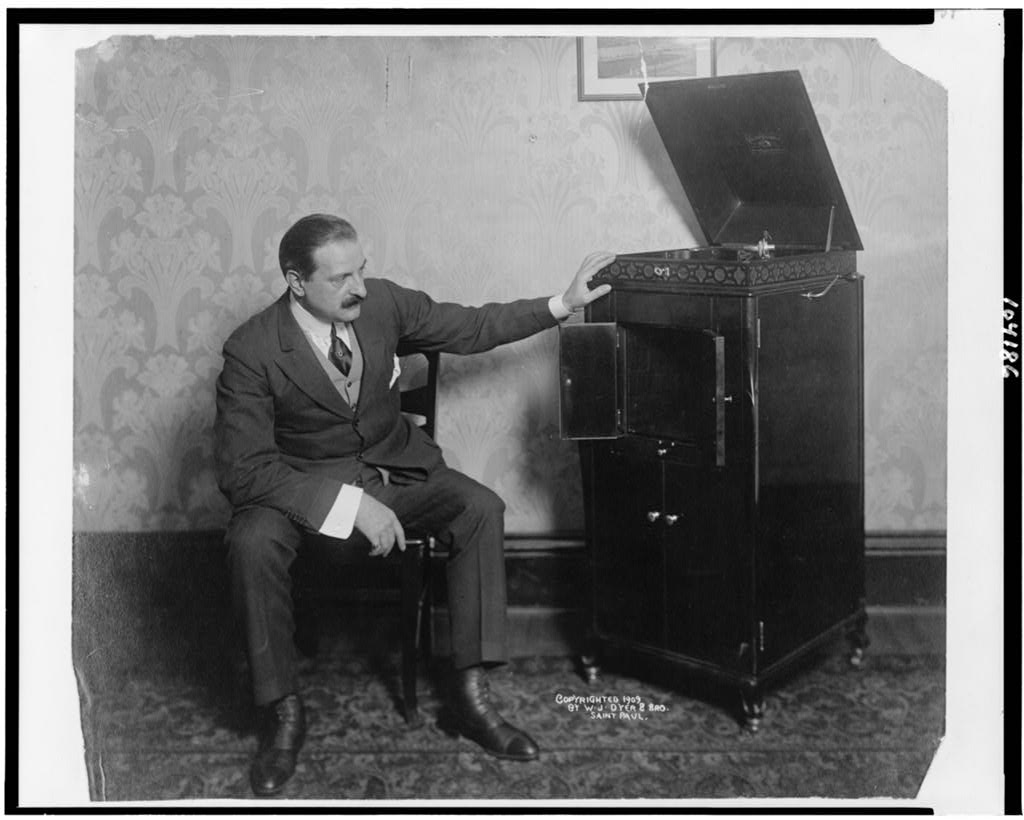
I gave myself an interesting assignment for my article in the Orange County Register today. Starting with the title above, I wrote it for the general reader who may be interested in trying classical music, but doesn’t know where to start. I run into well meaning citizens like that all the time.
Click here to read my article (one day pass or subscription required), or pick up a copy of Sunday’s newspaper.
“Rumors about the impending exit have swirled for months, reaching a crescendo in recent days.” — Christopher Knight, Los Angeles Times, July 24, 2013.
Awhile back I commented on music critic Scott Cantrell’s non-use of the word crescendo, the implication being that the word is too technical for a general circulation newspaper. I disagreed, asserting that it’s a perfectly good word, found in Webster’s no less, and an easy concept to understand.
Along comes Kingsley Amis. In his “The King’s English: A Guide to Modern Usage,” he has this typically curmudgeonly thing to say on the topic:
“Once a musical term meaning ‘(passage played) with increasing volume’ and a derived figurative term meaning ‘progress towards a climax’. For many years now taken to be a fancy synonym for ‘climax’ as in ‘the gunfire reached a crescendo’ or ‘the chorus of vilification rose to a crescendo’ and rendered useable only by the unwary or vulgar. Outside of a strictly musical context, that is.”
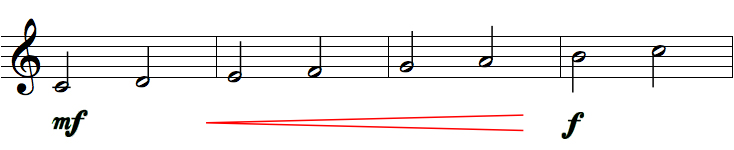
Yes. The important distinction to remember is that a crescendo is not a particular point in a musical composition, but a process therein, i.e. a process of getting louder. The musical marking for it is quite simple and illustrative, consisting of an elongated “lesser than” sign (as used in mathematics) placed directly under the passage for which the composer wants a gradual (or fairly sudden, but never instantaneous) increase in volume. A crescendo sign varies in length, depending upon the length of the crescendo desired.
The definition, however, is complicated, I now see, by Webster’s. The second definition of the word in my old collegiate edition says it’s synonymous with “climax,” which is entirely wrong from a musical point of view.
The longest crescendo in music is probably Ravel’s “Bolero,” which is, in fact, one long crescendo. Another very long crescendo occurs in the first movement of Shostakovich’s “Leningrad” Symphony. I’m not sure how long it is, exactly, but it’s something around 10 minutes I think. “Rossini crescendos” are much shorter but quite effective. The one in the Overture to “La Cenerentola” is particularly delicious.
Related posts: Another note on classical nomenclature; Premiere and premier

In today’s Orange County Register online, I review last night’s performance of “Le sacre du printemps” at the Hollywood Bowl. Rafael Frühbeck de Burgos conducted the Los Angeles Philharmonic. Augustin Hadelich was also on hand to play Tchaikovsky’s Violin Concerto.
Click here to read my review (one day pass or paid subscription required), or pick up a copy of tomorrow’s newspaper.
Bonus: My interview with Hadelich, from 2008. The link is free.
In today’s Orange County Register online, I review the iPalpiti Orchestral Ensemble of International Laureates, which played at Soka Performing Arts Center on Sunday afternoon. Conductor Eduard Schmieder and the group will perform the same program this Sunday at Walt Disney Concert Hall.
Click here to read my review (one day pass or paid subscription required), or pick up a copy of Tuesday’s newspaper.
After 90 days behind paywall bars, articles on ocregister.com are set free. Here are a couple more of mine from April, for those who are still interested. You may read them gratis.
Review: Great Britten from Pacific Chorale. April 22, 2013.
Pacific Chorale unveils 2013-14 schedule. April 23, 2013.


 Classical Life