Long Beach Opera 2012 season

Operas by Piazzolla, Poulenc, Martinu, Golijov and Nyman will be performed as part of the 2012 season of Long Beach Opera — not bad, not bad at all.

I’ve only ever heard one of them. How refreshing.

What’s missing from the typically adventurous agenda, however, is a visit to opera-deprived Orange County. The company has brought a production to Irvine in each of the last two years.

The season is launched with two performances (Jan. 29 and Feb. 4) of Astor Piazzolla’s “Maria de Buenos Aires,” a “tango operita” first given its West Coast premiere by LBO in 2004.

A rare double bill of Poulenc’s comedic “The Breasts of Tiresias” and Martinu’s jazz-inflected and dadaist “Tears of a Knife” will be staged in March.

Osvaldo Golijov’s acclaimed “Ainadamar,” an opera based on the life of Spanish poet Federico Garcia Lorca, is presented in May in what is billed as the West Coast’s first fully staged production of the 2005 edition.

British minimalist Michael Nyman’s “The Man Who Mistook His Wife for a Hat,” based on Oliver Sacks’ famous neurological study, winds up the season in June.

As in recent seasons, the company will present performances in a number of venues, some of them unusual, including the Warner Grand Theatre in San Pedro, a former movie palace, the Press-Telegram Building in Long Beach, and the EXPO Building in Long Beach, a former furniture store. Casting has yet to be announced, but I’m sure we can count on LBO’s regular and superb stable of singing-actors to be part of the fun.

In the news release announcing the season, Long Beach Opera also reported an unspecified increase in ticket sales last season, a 20 percent growth in its subscriber base, as well as an “unprecedented” number of sold-out performances — and that for a season of operas by Cherubini, Shostakovich, Glass and Lang.

Why the internet was invented

A  scene from “Lord of the Rings,” which some genius doctored for YouTube.

This is where the music came from.

You’re welcome.

Chicago Symphony program revealed

Riccardo Muti is my hero.

The program for Muti and the Chicago Symphony’s concert in Orange County on 17 February 2012 has finally been revealed in all its glory.

Muti and the gang will open with a performance of Arthur Honegger’s gritty tribute to trains, “Pacific 231.”

That is followed by a piece of genuine new music, “Alternative Energy” by Mason Bates, a Chicago Symphony commission.

After intermission, the musicians revive the Symphony by Cesar Franck. Incidentally, the Chicagoans made the best recording of the work, a veritable classic of the gramophone in my opinion, way back when.

In recent years, touring orchestras have been bringing almost stiflingly conservative programs to O.C. This one will be a breath of fresh air.

Single tickets go on sale Aug. 1, I believe. Sorry, I’m not 100 percent certain of the date.

UPDATE: Friend of Classical Life, conductor Chris Russell will be giving the pre-concert lecture for this concert.

Bruckner recordings

Alex Ross has an interesting list of his favorite Bruckner recordings, an addendum to his article in The New Yorker this week.

I haven’t heard all (or maybe any) of his favorites … just the same conductors leading different Bruckner symphonies.

He mentions Giulini’s recording of the Ninth with the Vienna Philharmonic, which I’ve always been meaning to get around to listening to but never quite have. Perhaps because Giulini’s recording of the same work with the Chicago Symphony is so awesome and satisfying, the kind you can slap on the stereo to impress your friends with.

I’ve been thinking for a couple days now, and I don’t really have too many Bruckner recordings to add to Alex’s list.

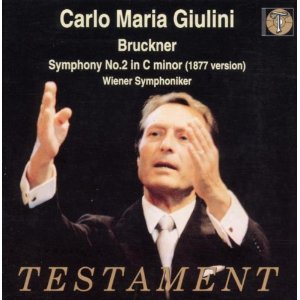
I’d add a relatively little-known account of the  Symphony No. 2, led (again) by Giulini, this time with the Vienna Symphony. It’s really a must-have for Brucknerites.

As for the Symphony No. 6 (Alex recommends Klemperer), I’d say Daniel Barenboim’s early recording with the Chicago Symphony on DG is pretty hard to beat. But good luck finding it.

Alex, who cut his Brucknerian teeth on Karajan’s DG recordings (I did too), didn’t find them as impressive when he listened to them again recently. I wonder why, and whether or not it might be the CD transfers. The vinyl of same had a magical hue, an extra bonus added by the engineers, and nothing to sniff at.

At any rate, I still count Karajan’s first DG account of the Fourth Symphony (no, not the one on EMI) as the best recording of that work. But then, you shouldn’t trust me, because it was my first record, and first records always hold something extra special for those who bought them.

But the post has piqued my curiosity, and I listened to quite a bit of Eugen Jochum’s account of the Eighth today … in the car. Bruckner must be the absolute worst composer to listen to in the car, because to hear the soft stuff (at least in my car) you have to turn the volume way up, and you know what that means — the loud stuff blows you out of your seat.

I’ve also managed to put my hands on Karl Bohm’s famous and much-admired recording of the Fourth with the Vienna Philharmonic (it took a little digging). I’ve never heard it, but thanks to Alex, I will in the next few days.

What are some of your favorite Bruckner recordings? Please, dear blognescenti, name them in the comments section.

From the archives: The Musical Mangans

Rear, from left to right: Betty (Mom), Laurel, Dennis, Rick and Richard (Dad).

The little fellow in the front, paying no attention to the musical goings on, is me (Tim).

Someone, don’t know who, has written “Wagnerian Camera Mugger” on the photo, apparently in reference to me.

The photo was taken c. summer, 1961, in our home.

I suspect it is a photo taken by our local newspaper. My mother ran an amateur Broadway troupe called “The Coronaires” (we lived in Corona, CA). I grew up around productions of “South Pacific,” “The Music Man,” “Pajama Game,” “Oklahoma!” and many others.

No, we didn’t stand around singing like this, not to my recollection. But all of us, at one time or another, appeared in my mother’s musical productions, in parts big and small. My father once sang the role of Emile de Becque in “South Pacific.” My mother always conducted the orchestra.

Mom and Dad had different musical tastes. You will see this in the photo. Behind my father on the floor is a “Party Along with Mitch [Miller]” record — that’s his. On the mantle is a recording of “La Traviata” — that’s Mom’s.

Dad is wearing a bow tie. He got into the habit in medical school, when he found his long ties dangled inside the cadavers they were studying.

Above the piano is a painting by one of my aunts, I believe. The piano is a Chickering, and we still have it.

Click on the photo to see a larger view.

Summertime tempos

Should tempos in the summertime be faster?

Last week I heard two performances of the Mussorgsky/Ravel “Pictures at an Exhibition,” the first at the Hollywood Bowl conducted by Gustavo Dudamel and the second at Verizon Wireless Amphitheater conducted by Carl St.Clair. I didn’t mind. I like the piece, and unlike some others, never seem to tire of it. Both were satisfactory readings, and sometimes even better.

But there were moments in both performances where I couldn’t help thinking to myself, “OK, get on with it already.”

Neither conductor took unduly slow tempos, though both resorted to a rather stately pace now and then.

I think those tempos (the stately ones) would have worked better indoors.

Outdoors, with the unfortunately necessary amplification in place, a listener does not feel the full effect of a slower tempo, as one does indoors. For one thing, the music just doesn’t sound as good on a purely sensual level; the color is sapped and the power falsely boosted by the amplification.

A listener is more focused on line outdoors, rather than things like the orchestration, color, atmosphere.

Secondly, outdoors, the repertoire tends to be thrice familiar. Transitional passages bore, partly because we already know where they are going and want to get there (though that would also hold for indoor performances, to a degree) and partly because they don’t always have the interest of the main line of the argument, to which I have already asserted the listener is more focused on in al fresco concerts. Also, whatever purely sonorous interest these transitional passages may have is, again, sapped.

(I once was chatting with Pierre Boulez about Mahler’s Fifth Symphony, which he said had some weak passages therein. We didn’t get into where they were, but I asked him what he did, as a conductor, during those passages. He said simply, “I go faster.” I thought he was being funny for a split second, but he was completely serious.)

I found the “Promenades,” or many of them, tedious, in both Dudamel’s and St.Clair’s accounts of “Pictures.” I wanted them to get on with it already. The “Promenades” are, at least in part, transitional passages, and though hardly weak in indoor performances, seemed to just be marking time (no pun intended) outdoors.

Now, any conductor worth his salt will take into consideration the acoustics of a hall in setting tempos for a piece.  Most conductors probably do it without even thinking about it. I doubt Dudamel or St.Clair could hear what the music sounded like out in the amphitheaters, however, so they may not have even thought about it, and just went ahead and laid on us their indoor interpretations of “Pictures”.

Karl Bohm conducts Mozart

This is a film (with a set, lighting, tracking shots, etc.) of Karl Bohm conducting the Vienna Symphony in the first movement of Mozart’s Symphony No. 39, judging from the looks of it, in the late 60s or early 70s.

The 5 Browns perform with the Pacific Symphony at Verizon

In today’s Orange County Register online, I review The Five Browns, Carl. St.Clair and the Pacific Symphony in a “tweetcert” at Verizon Wireless Amphitheater. CLICK HERE TO READ MY REVIEW, or pick up a copy of tomorrow’s newspaper.

Classical Life celebrates first birthday

Classical Life is one year old today.

It’s been a very good year. Well, a year.

You were shocked — shocked! — to find that I had been “re-assigned.”

You wanted to know, “Where on earth is Gustavo Dudamel?”

The Top Ten Greatest Notes of All Time stirred sectarian strife.

10 Giulini recordings soothed the savage breast.

You could hardly get enough of Gustavo Dudamel and Juan Diego Florez opening the 92nd season of the L.A. Philharmonic, and, my god, who can blame you?

You were almost as equally mesmerized by my first record, though.

Still, it wasn’t enough. You wanted more Giulini, so I attempted to serve his genius.

Yeah, yeah, but how about a 3-year-old conducting Beethoven, you said.

He was much better than annoying sounds.

Still, musicians didn’t comment.

Stay thirsty, my friends.

The Carmageddon ‘Turandot’

One of the biggest operatic events of the season takes place this weekend at the Hollywood Bowl, when Gustavo Dudamel conducts the Los Angeles Philharmonic and a cast that includes Christine Brewer in a performance of Puccini’s “Turandot.”

Problem is, it will occur during the complete shut down of the 405 freeway between the 10 and the 101. Predictions are dire for the weekend — an apocalyptic traffic jam engulfing not only the 405, but the freeways around it, including the 101, upon which sits, a few miles from the shutdown interchange, the Hollywood Bowl.

Getting to the Bowl under normal circumstances is no walk in the park. Sunday, it could be horrific.

However, I really have no idea what will happen, and do not foretell anything. Last time massive gridlock was predicted for L.A. — during the 1984 Olympics — everyone stayed off the freeways, and getting around was a dream. It might happen Sunday too. Certainly, everyone has been warned.