Myra Hess plays her own arrangement of Bach’s “Jesu, Joy of Man’s Desiring.”
Related post:
Myra Hess plays her own arrangement of Bach’s “Jesu, Joy of Man’s Desiring.”
Related post:

As previously reported in this space, Soka University in Aliso Viejo will unveil the new Soka Performing Arts Center on Sept. 17. The big hall’s acoustics come courtesy of Yasuhisa Toyota, the gentleman responsible for Disney Hall’s wonderful acoustics.
I finally discovered what Carl St.Clair and the Pacific Symphony will perform for the occasion:
A Short Ride in a Fast Machine (John Adams)
Piano Concerto No. 2 (Rachmaninoff, Horacio Gutiérrez, soloist)
Suite from Romeo and Juliet (Prokofiev)
Suite No. 2 from Daphnis and Chloe (Ravel)
When I first saw the program, I didn’t like it much. It seemed to me that it failed to rise to the festive occasion, and, what’s more, consisted of quite a few works that are oft-heard.
Upon further rumination, however, I can see this program’s merits, not the least of which being that it will serve as a fair demonstration of the hall’s acoustical merits — with the muscle and brilliance of Prokofiev, the clarity and delicacy of the Ravel, the sumptuousness of the Rachmaninoff, with a soloist to see how that works, and a nice, peppy modern work, not too difficult for the hoi polloi, if that’s the word I want.
It’s a nice gamut, I think, even if I do have to sit through the Rachmaninoff again.
Review: Long Beach Opera’s production of Shostakovich’s Moscow, Cherry Town. Opera News, August 2011.
Incidentally, Mr. Eduard Khil — aka Mr. Trololo — has a small part (“vocalist”) in the movie version of Shostakovich’s operetta, now available on DVD under the title of Cherry Town or Cheryomushki.
I happened upon Los Angeles Opera’s re-designed website the other day and immediately noticed a bold, new marketing initiative designed, no doubt, to bring in the novice listener, the kind that is frightened of opera, or otherwise unsure of the art form. “Lose Yourself In Opera” the site encourages, and then offers some helpful hints on how you might go about doing that.
For instance, you might buy a ticket to something called Eugene Onegin. “What that?” you say. “From the composer of Swan Lake!” LA Opera answers. (Gosh, is Natalie Portman in it? She’s hot.)
Or how does Romeo et Juliette strike your fancy? Too French? Unsure? It’s “The World’s Most Famous Love Story,” LA Opera explains and then as it dawns on you that it’s that Romeo and Juliet you click on the icon and buy a ticket. Simple.
Getting into the spirit, I offer the following, free of charge, to the marketers at LA Opera.
Wozzeck — Pronounced Vots-eck, more or less!
Die Walküre — From the composer of “What’s Opera, Doc?” only longer!
Götterdämmerung — The fat lady sings at the end!
Tristan und Isolde — The fat lady sings at the end!
The Turn of the Screw — Sounds like porn, and it kind of is!
Die Soldaten — From the composer of Photoptosis!
Rigoletto — We have a hunch you’ll like this one!
La Boheme — Based on Rent!
The Marriage of Figaro — Features a chick dressed as a man!
Giulio Cesare — A bunch of dudes singing like chicks!
Cosi fan tutte — Can you say Swingers?!
Porgy and Bess — From the composer of the United Airlines commercial!
Carmen — Smokes cigarettes and kills men, but you can dance to it!
La Traviata — Consumption never sounded so good!
Salome — Like David Lynch on steroids!
The Breasts of Tiresias — An entire opera about boobs!
I opened up the Los Angeles Times this morning (I still subscribe to the print version) and found, in the front page index box, a little photo of Yuja Wang in that little red dress, a promo for a story in Calendar, the newspaper’s arts and entertainment section. ‘Her again?’ I thought in my semi-conscious, pre-caffeinated state.
Splashed above the fold in Calendar was yet another photo of Wang, in full color and skimpy regalia, strutting her considerable stuff upon the Hollywood Bowl stage. Below were not one, but two, full-length stories, one by Times’ music critic Mark Swed, both jumping to a considerable spread inside, and discussing and parsing and analyzing said dress into its constituent parts and meanings. At least I think that’s what they were about — I didn’t read either one.
Personally, I don’t find the story interesting. Am I a snob? Possibly. But it’s more that I find the Yuja Wang scandal, if that’s what it is, terribly predictable. I already know what everyone will say, blah, blah, blah and yadda, yadda, yadda, and so, dear reader, do you. And at this point, as the story has spread throughout the internet, everything that can possibly be said about Yuja Wang’s dress has been said.
But I don’t blame the Times, or not much. I know what happened. They got a ton of hits on Mark’s review of Yuja Wang’s dress and they saw the folks all over the internet discussing Mark’s review of Yuja Wang’s dress and they thought — since they’re a business and all — that maybe they ought to follow up on Yuja Wang’s dress.
Yuja Wang gets a lot of hits at Classical Life, too. A few days ago, I posted Yuja Wang’s little red dress, and it has been topping my hit parade ever since, even though I had virtually nothing to say about Wang and her dress. The headline was enough to attract readers. I can see on my blog dashboard that readers are searching for stories about Yuja Wang’s dress. Among the search terms used this morning that brought readers to this blog (according to the dashboard), 15 of them involved Yuja Wang, some of them used multiple times. Included among them: “Yuja Wang is hot” and “little red dress.”
The same phenomenon is behind much that is covered in the media today. Online, they know what you’re reading, and they know what you’re not reading, and so, naturally (but stupidly in my opinion, but we won’t get into that now), the media gives readers (and viewers) what they want. I got upwards of 13,000 hits on a story I wrote for my newspaper recently, and something like 120 comments, which is considerably more than I ever got for a story on classical music.
Was it brilliant? Certainly not. Was it interesting? Not really. But it was about Rebecca Black. And as long as readers keep clicking on stories about Rebecca Black and Yuja Wang, newspapers are going to keep writing same.
Georges Pretre conducts the Vienna Philharmonic in the 2008 New Year’s Concert. The first piece is the lovely Die Libelle (The Dragonfly) by Johann Strauss, Jr. I first heard it in an even more enchanting performance led by Carlos Kleiber, which unfortunately they won’t let me share with you here. (Click on the link.)
I’d love to hear this played as an encore sometime, perhaps after a stormy symphony by Tchaikovsky or Mahler.
The second work on the video is Die Pariserin, also by Johann, Jr., a “polka francaise” here performed as a little ballet for horses.
The little red dress that pianist Yuja Wang wore recently for a concert at the Hollywood Bowl is the hot topic of discussion these days on the classical internets. Start with Iron Tongue of Midnight, where Lisa links you up with other online discussions about said dress and adds some astute commentary herself. (I only disagree with her on the topic of music critics mentioning fashion — I think we should.) …
CK Dexter Haven, friend of Classical Life, has started his own blog, All is Yar. Among other yummy things, he gets a lot of inside dope on the musicians of the L.A. Phil. I’ve added his site to the blogroll. …
Johnny Carson plays the theremin, courtesy of Alex Ross. … It used to be that the talk shows and variety shows featured classical musicians, giving them valuable exposure to the masses. Itzhak Perlman ended up on Hollywood Squares, thanks to his appearances on Carson. …
In 1956, the great Hollywood film composer Dimitri Tiomkin stumps ’em on What’s My Line. …
Meanwhile, I’ve been engaged in much more important controversies, including, but by no means limited to, the sex life of Muppets.
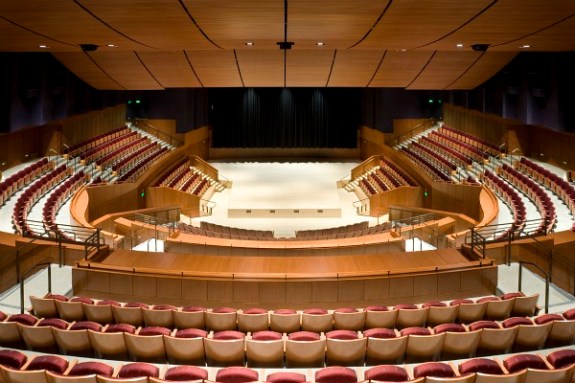
Soka University in Aliso Viejo will inaugurate the new Soka University Performing Arts Center this fall with a black-tie concert and reception on Sept. 17 featuring Carl St.Clair and the Pacific Symphony, with pianist Horacio Gutiérrez as soloist.
The handsome Soka Performing Arts Center, designed by Zimmer Gunsul Frasca Architects in Los Angeles, looks especially promising; it features a 1000-seat multi-purpose concert hall with acoustics credited to Yasuhisa Toyota, the same genius behind the sound of Walt Disney Concert Hall. An adjacent building, the Nelson Mandela Hall, has a 180-seat black box theater as part of its accoutrements. Together, they cost $73 million.
After the opening, Soka will offer, among many other events, an ambitious season of classical fare, which includes two more visits by the Pacific Symphony, the St. Petersburg Symphony (from Russia), the New Zealand String Quartet, the Tokyo String Quartet and a solo recital by pianist Emanuel Ax.
For more information go to http://www.soka.edu. For tickets call 949-480-4ART or visit tickets@soka.edu.
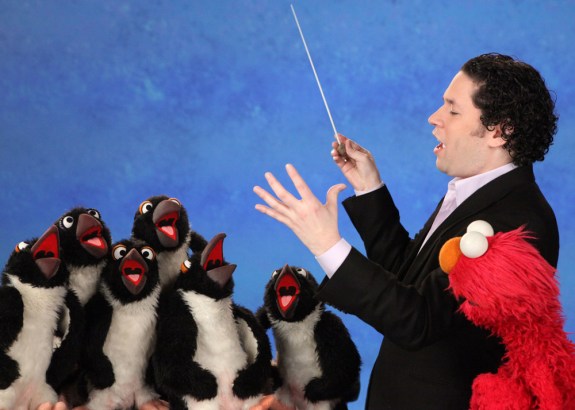
Los Angeles Philharmonic music director Gustavo Dudamel will make an appearance on “Sesame Street” on an undisclosed (but soon to be announced) date in the near future, according to a press release from the orchestra.
No other details about said appearance are available at this time, but the Philharmonic did provide the photo above.
I’ll definitely watch. I heart Elmo. And Penguins. And the Dude, too.
photo: courtesy of Los Angeles Philharmonic
The Philharmonic Society of Orange County, the area’s venerable and most ambitious presenter of classical music, reported an (unaudited) surplus of $115,675 for the season (fiscal year ending June 30).
Total revenues (including tickets sales and donations) were $4,238,033 and total expenses were $4,122,358.
Though belts have tightened at the non-profit in recent years, they’re managing.
Maybe more than managing. The Philharmonic Society’s upcoming season will feature performances by the Chicago Symphony, the Cleveland Orchestra, the New York Philharmonic, the Baltimore Symphony, the Los Angeles Philharmonic and the Mariinsky Theatre Orchestra, among others.



