I’ve added 10 more recordings to my Recommended Recordings page, above. The new ones are Nos. 11-20. You should be able to click on the thumbnails to view larger photos of the covers. All are available on Amazon and other online retailers, and most if not all can be had as MP3s.
My selections are quite random. I’m just remembering recordings that I especially like. If there is a particular piece that you would like me to recommend a recording of, drop a line in the comments below this post (not on the Recommended Recordings page). If I can’t recommend one, I’m sure other readers can.
In today’s Orange County Register online, I review Carl St.Clair and the Pacific Symphony in a performance of a Golijov/Chopin/Tchaikovsky program, heard Thursday night in Segerstrom Concert Hall.
Back in my high school days, I took a trip with some friends in a giant 1966 Imperial to Magic Mountain, some 75 miles north of Orange County. Partway there, the car broke down on the freeway. We parked it on the side of the road and began walking to get help. We were in Pacoima, a rather forlorn place, just walking through some random neighborhood when we came upon a house with an open garage. A big band was set up there, and they were rehearsing. Kids were playing in the driveway, as if nothing was unusual here. My friends and I were, of course, astonished. I asked one of the kids on a bicycle, “What’s this?”
“It’s jazz, man,” he said. “It’s been around for years.”
It was rather amusing to be sitting in Segerstrom Concert Hall on Saturday night, observing the unsuspecting audience as pianist Marino Formenti unleashed Evan Gardner’s “Variations on a Theme by John Cage” for piano and live electronics. I wanted to say, “It’s avant-garde, man, it’s been around for years,” but an audience like this one (there for a nice pleasant piano recital, in our beautiful new hall, safe to say) really has no basis for understanding a work like Gardner’s. It was a case of a piece intended for a different type of listener (an elite one) meeting an audience of ordinary folk (no offense).
Not that I could make much sense of it either. Gardner’s work (heard here in its U.S. premiere) takes as its theme Cage’s 4’33’’—that is, his famous (or infamous) silent piece for solo piano. A little more explanation than was provided by the program note, and by the composer speaking just before the performance, would have possibly helped. One found it difficult to ascertain under what rules the piece was formed and under what processes the sounds were being produced.
In short, Formenti wore some electronic gloves and didn’t touch the keyboard.
Yes, I’m that old. This is Marty Robbins singing “El Paso.” It was No. 1 on the Billboard singles chart on January … but let’s not be pedantic.
You can find out the No. 1 tune on the day you were born fairly easily. Just Google “No. 1 pop song March 21, 1965,” or whatever your date is. Wikipedia has the lists, year by year, week by week.
Tonight, KOCE (aka PBS SoCal) will broadcast the New Year’s Concert from Vienna at the odd time of 6 p.m. It’s usually one of my favorite classical broadcasts of the year (especially if there’s a good conductor, as is the case tonight), but then I like Johann Strauss. Mariss Jansons will lead the Vienna Philharmonic, brought to you direct from the Musikverein. Julie Andrews hosts.
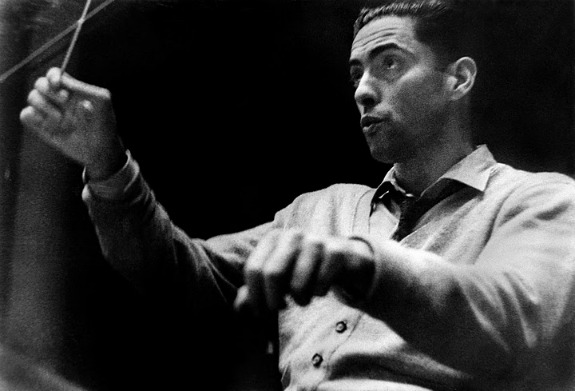
Above, Carlos Kleiber conducts the Wieners in the 1989 New Year’s concert.
I’ve posted tonight’s musical program below. There are a number of the usual suspects, of course, but also some out of the way items. The concert, as always, will end with a pair of traditional encores — the “Blue Danube” Waltz and the “Radetzky” March.
Program:
Johann and Joseph Strauss: “Vaterländischer Marsch (Fatherland March)”
Johann Strauss: “Rathausball-Tänze (City Hall Ball Dances)”, Waltz, op. 438
Johann Strauss: “Entweder – oder! (Either – Or!)”, Fast Polka, op. 403
Johann Strauss: “Tritsch-Tratsch (Chit-Chat)”, Polka, op. 214
Carl Michael Ziehrer: “Wiener Bürger (Viennese Folk)”, Waltz, op. 419
Johann Strauss: “Albion Polka”, op. 102
Joseph Strauss: “Jokey Polka (Jockey Polka)”, Fast Polka, op. 278
– Intermission –
Joseph Hellmesberger, Jr.: Danse Diabolique (Diabolic Dance)
Joseph Strauss: “Künstler-Gruss (Artists Greeting)”, Polka française, op. 274
Johann Strauss: “Freuet euch des Lebens (Enjoy Life)”, Waltz, op. 340
Johann Strauss, Sr.: “Sperl Galopp”, op. 42
Hans Christian Lumbye: Copenhagen Railway Steam Gallop
Joseph Strauss: “Feuerfest (Fireproof)”, Polka française, op. 269
Eduard Strauss: “Carmen-Quadrille”, op. 134
Peter I. Tchaikovsky: “Panorama” from the Ballet “Sleeping Beauty”, op. 66
Peter I. Tchaikovsky: “Waltz” from the Ballet “Sleeping Beauty”, op. 66
Johann and Joseph Strauss: “Pizzicato Polka”, no opus number
Johann Strauss: “Persischer Marsch (Persian March)”, op. 289
Joseph Strauss: “Brennende Liebe (Burning Love)”, Polka Mazur, op. 129
Joseph Strauss: “Delirien (Delirium)”, Waltz, op. 212
Johann Strauss: “Unter Donner und Blitz (Thunder and Lightning)”, Fast Polka, op. 324
Merry Christmas, everyone, from the producer of this blog. I appreciate your continued readership.
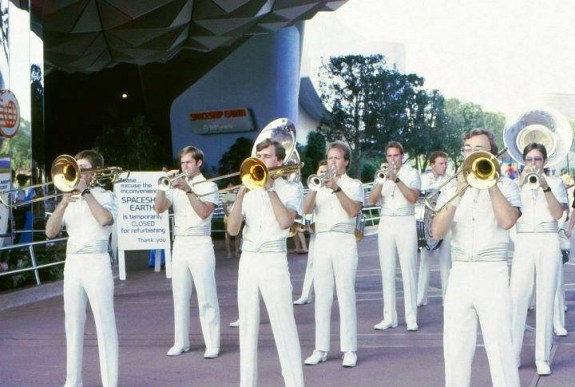
And though I can’t speak for all of them, I’m certain the Future World Brass (pictured) wishes you all the best as well. The photo dates from 1982 or 1983. It was taken at EPCOT Center in Orlando, Florida. That’s yours truly, front and center. Yes, I was a member of the band, my first professional gig out of college.
Someday, I’ll have to relate the saga of the Future World Brass and my membership therein.
There will be no cash prize awarded for the best comment …