Yes, I’m that old. This is Marty Robbins singing “El Paso.” It was No. 1 on the Billboard singles chart on January … but let’s not be pedantic.
You can find out the No. 1 tune on the day you were born fairly easily. Just Google “No. 1 pop song March 21, 1965,” or whatever your date is. Wikipedia has the lists, year by year, week by week.
Tonight, KOCE (aka PBS SoCal) will broadcast the New Year’s Concert from Vienna at the odd time of 6 p.m. It’s usually one of my favorite classical broadcasts of the year (especially if there’s a good conductor, as is the case tonight), but then I like Johann Strauss. Mariss Jansons will lead the Vienna Philharmonic, brought to you direct from the Musikverein. Julie Andrews hosts.
Above, Carlos Kleiber conducts the Wieners in the 1989 New Year’s concert.
I’ve posted tonight’s musical program below. There are a number of the usual suspects, of course, but also some out of the way items. The concert, as always, will end with a pair of traditional encores — the “Blue Danube” Waltz and the “Radetzky” March.
Program:
Johann and Joseph Strauss: “Vaterländischer Marsch (Fatherland March)”
Johann Strauss: “Rathausball-Tänze (City Hall Ball Dances)”, Waltz, op. 438
Johann Strauss: “Entweder – oder! (Either – Or!)”, Fast Polka, op. 403
Johann Strauss: “Tritsch-Tratsch (Chit-Chat)”, Polka, op. 214
Carl Michael Ziehrer: “Wiener Bürger (Viennese Folk)”, Waltz, op. 419
Johann Strauss: “Albion Polka”, op. 102
Joseph Strauss: “Jokey Polka (Jockey Polka)”, Fast Polka, op. 278
– Intermission –
Joseph Hellmesberger, Jr.: Danse Diabolique (Diabolic Dance)
Joseph Strauss: “Künstler-Gruss (Artists Greeting)”, Polka française, op. 274
Johann Strauss: “Freuet euch des Lebens (Enjoy Life)”, Waltz, op. 340
Johann Strauss, Sr.: “Sperl Galopp”, op. 42
Hans Christian Lumbye: Copenhagen Railway Steam Gallop
Joseph Strauss: “Feuerfest (Fireproof)”, Polka française, op. 269
Eduard Strauss: “Carmen-Quadrille”, op. 134
Peter I. Tchaikovsky: “Panorama” from the Ballet “Sleeping Beauty”, op. 66
Peter I. Tchaikovsky: “Waltz” from the Ballet “Sleeping Beauty”, op. 66
Johann and Joseph Strauss: “Pizzicato Polka”, no opus number
Johann Strauss: “Persischer Marsch (Persian March)”, op. 289
Joseph Strauss: “Brennende Liebe (Burning Love)”, Polka Mazur, op. 129
Joseph Strauss: “Delirien (Delirium)”, Waltz, op. 212
Johann Strauss: “Unter Donner und Blitz (Thunder and Lightning)”, Fast Polka, op. 324
Merry Christmas, everyone, from the producer of this blog. I appreciate your continued readership.
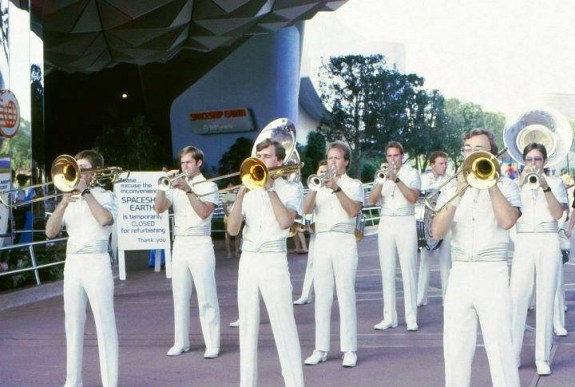
And though I can’t speak for all of them, I’m certain the Future World Brass (pictured) wishes you all the best as well. The photo dates from 1982 or 1983. It was taken at EPCOT Center in Orlando, Florida. That’s yours truly, front and center. Yes, I was a member of the band, my first professional gig out of college.
Someday, I’ll have to relate the saga of the Future World Brass and my membership therein.
There will be no cash prize awarded for the best comment …
On “All Things Considered,” they’re running a “Winter Songs” series, in which they ask various folks to pick their favorite songs in the category. Last night, they spoke to the choreographer Bill T. Jones, and he chose Schubert’s “Der Leiermann” (The Hurdy-Gurdy Man), the last song in Schubert’s song cycle “Winterreise.”
Jones spoke of the song’s meaning for him:
” … this bleak landscape takes me back to a day when I was in fourth grade out on the edge of town, looking at a snow-covered highway many, many yards away from my window — I should’ve been paying attention, but I was dreaming.
“And then I saw a lone figure walking across on a very, very cold day, and you know how it is when the wind blows and you have to turn your back against the wind, and I felt so sorry for that person, and then I realized it was my father. That my father, who was completely out of work, had been the director of his own business as a contractor in the heyday of the migrant stream back in the late ’50s, but now that business had died.
“He was up in the chilly North with family, broke and sick, and he had to get to this very insignificant job in a factory, miles and miles away. A black man with no car, trying to hitchhike, and no one picking him up, and he has to walk that 10 miles to get to the factory. And I’m sitting in this warm classroom, getting educated, not paying attention to the teacher, and suddenly feeling torn between two worlds. And this music, when I hear it, I feel for my father. There’s something about art that can be, yes, depressing, but helps us bear the pain through sheer beauty and intensity.”
In today’s Orange County Register online, I review a performance of the Pacific Symphony, conducted by violinist Henning Kraggerud, in a Baroque program.
The concert that Esa-Pekka Salonen conducted Saturday night at Walt Disney Concert Hall was enjoyable, in no small part, for what it didn’t have. There weren’t any familiar works on the program, a circumstance that has the tendency to keep a listener on his toes. There weren’t any masterpieces either, at least not of the certified variety, which was a sort of relief from the museum aura that so many programs have, where the listener sits in a pool of awe, admiring. No one talked about the music at concert time, explaining it and nudging our judgments. The only words that Salonen uttered were an introduction to a distinguished guest in the audience, Irina Shostakovich, the composer’s widow.
There is a kind of absence in Salonen’s conducting, too, that makes it enjoyable. He doesn’t put a lot of spin on the music, doesn’t grandstand with it, or milk it. One felt that the music was put first Saturday night, and Salonen stood out of the way. That is not to say he didn’t do anything, however. The performances maintained a remarkable energy throughout and, in the case of the second work on the program, a noticeably practiced hand was at work in the pacing. What’s more, the orchestra was in excellent fettle and played with that fine clarity of texture that Salonen has long been noted for.
The big news was the world premiere of “Orango,” an uncompleted opera by Shostakovich written in 1932, and only rediscovered in 2004. The composer finished the Prologue in piano/vocal score and Shostakovich scholar Gerard McBurney orchestrated it, basing his work on other Shostakovich works of the time and on the ballet “The Bolt,” two sections of which the composer reused here. The Prologue lasts around 40 minutes.




 Classical Life