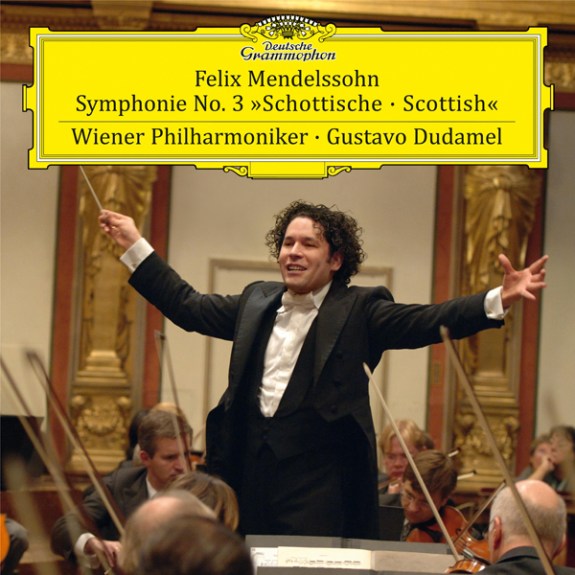
Record Store Day: Gustavo Dudamel gets his Old School on

Today, April 21, as part of Record Store Day, Deutsche Grammophon is releasing a new recording of Mendelssohn’s “Scottish” Symphony performed by the Vienna Philharmonic under the baton of Gustavo Dudamel.

It’s an LP. As in, on vinyl. And you can’t get it in any other format.

Record Store Day is an annual event that helps celebrate and promote independent record stores. (Remember them?) 1000 stores in the U.S. are expected to participate this year. On this day, as far as I can tell, a bunch of new vinyl is released for the occasion, in limited quantities — mostly pop, rock and alternative musics. The release of the Dudamel recording reportedly marks the first time a classical music label has participated in the event.

Vinyl is still around. It’s kind of the in thing with a certain crowd, and big name groups often put out special vinyl recordings.  There’s a Record Store Day website where you can type in your zip code and find the participating outlets near you. I did that last night and found Sound Spectrum — Music & Memorabilia in Laguna Beach.

I phoned them last night to see if they’d have the Dudamel release. A friendly, very cool gentleman answered (he sounded like a hippie version of  Chuck Niles). Anyway, it seems that independent record stores who participate in the event only order the vinyl they want for Record Store Day. The Sound Spectrum gentleman said they wouldn’t be getting the Dudamel record. I asked him if he knew who Dudamel was. “Of course,” he said. “But I couldn’t sell it.” He said he did have a Leonard Cohen record that I might like, though. He suggested I call him back on Monday, when he could probably order me a copy of the Dudamel. I may.

I checked Amazon for it. The website informs that the record is “Exclusive RSD 180 gram vinyl” — whatever that means, it sounds good. Amazon doesn’t have it, though. But I could get a copy for $29.99 from Jackalope Records through the site.

From DG’s press release:

“This performance was recorded in the Musikverein in December 2011 and is issued here for the benefit of aspiring young musicians in Venezuela’s remarkable El Sistema. Its LP-only release, the first of a Vienna Philharmonic recording in over two decades, is also significant. Gustavo Dudamel has never lost a special fondness for the vinyl records he associates with his earliest musical memories. Tellingly, his favourite 30th-birthday present in January 2011, received with an ear-to-ear grin after conducting in Cologne, was a stack of LPs from Deutsche Grammophon.”

The Dudamel/Vienna recording will be more widely available on May 22, but only on vinyl.

I still listen to and enjoy vinyl, though not exclusively. Some of my old vinyl sounds great, in some cases better than any other format. But never mind. I won’t advocate for it because it’s a lost cause. Still, I see at least one technological (or maybe I should say, design) advantage to vinyl, and that is it’s non-portability. When you put a record on, you pretty much have to sit down and listen to it.
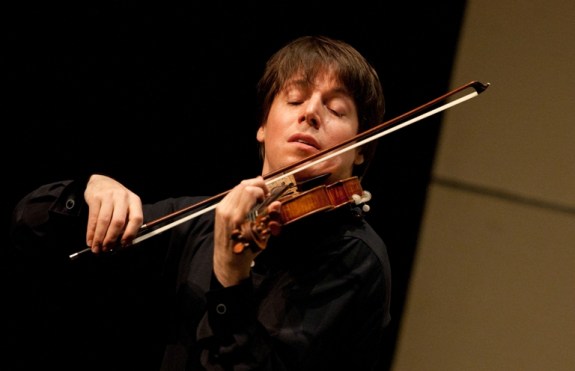
Joshua Bell makes surprise appearance on TMZ

I had the pleasure of speaking with violinist Joshua Bell recently. We spoke for only 15 minutes, but, well, I’m a busy man. Anyway, among the things we talked about was his recent appearance on TMZ — not his own doing, the result of a robbery. He performs in O.C. on April 26.

Click here to read my interview with Bell, or pick up a copy of Sunday’s Orange County Register.

photo: Eric Kabik

‘Boheme’ revived, courtesy of the Pacific Symphony

In today’s Orange County Register online, I review the Pacific Symphony’s semi-staged performance of ‘La Boheme,’ part of an effort to bring opera back to Orange County.

Click here to read my review, or pick up a copy of tomorrow’s newspaper.

Franz Welser-Möst and the Cleveland Orchestra perform Shostakovich, Saariaho

In today’s Orange County Register online, I review last night’s performance of the Cleveland Orchestra, conducted by Franz Welser-Möst.

Click here to read my review, or pick up a copy of tomorrow’s newspaper.

The editor and the critic

Originally published March 2007.

The other day, while reading a novel called “Kipps” (awfully good), I came to the following sentences:

His aunt and uncle were, as it were, the immediate gods of this world, and, like the gods of the world of old, occasionally descended right into it, with arbitrary injunctions and disproportionate punishments. And, unhappily, one rose to their Olympian level at meals.

The word “Olympian” was footnoted (actually, endnoted), but I ignored it at the time, only to come across the explanation in the back a short time later.

Olympian: Olympus, in Greek mythology, was the home of the gods: hence high, mighty, of divine standard.

I cringed. Have we really declined to the level that “Olympian” needs explaining? Is there any hope for, say, Beethoven? You know, the deaf composer. Perhaps there never was. In 1925, H.L. Mencken, reporting on the Scopes trial (sorry, no footnote), put it this way:

The intellectual heritage of the race belongs to the minority, and to the minority only. The majority has no more to do with it than it has to do with ecclesiastic politics on Mars. In so far as that heritage is apprehended, it is viewed with enmity. But in the main it is not apprehended at all.

Read more…

The composer and the critic

Originally published April 2007.

Composers are good interviews. They tend to be smart and they seem to enjoy talking, especially about their own music. They spend a lot of time alone working at their craft, so maybe they welcome the opportunity for human contact more than others. That time alone also seems to turn them into philosophers of a sort — they can speak deeply about music, better than most.

I phoned a composer the other day. We talked about his new piece (which was to be performed soon) and had a good, friendly, stimulating chat. He was a nice guy, I liked him, and I think he felt the same about me. Of course, he probably knew that I would also be reviewing his new work, so he had a motivation for being friendly. Not that I took that cynical view.

In a perfect world, I wouldn’t be interviewing anyone that I was about to review. At least that’s the way I used to think. A critic should be dispassionate and objective when reviewing, I think, neither rooting nor seeking to tear down, and if you know the person you are reviewing, even a little, that can be difficult. My talk with this composer made me more sympathetic to him than was perhaps ideal.

Read more…

Kristof Barati plays ‘Der Erlkönig’

Kristof Barati takes a ride through Ernst’s arrangment of Schubert’s “Der Erlkönig.” The violin is a Guarneri made in 1741.

Guest blog: River North Dance Chicago launches Laguna Dance Festival

Laura Bleiberg reviews:

River North Dance Chicago on Thursday kicked off day one of Laguna Dance Festival. This is the festival’s seventh season of dance performances, master classes and collaborations with art galleries, all in Laguna Beach.

River North has been a regular visitor to Southern California in the past six months, with shows at the Cerritos Center and the Smothers Theatre in Malibu. The audience cheered lustily, nonetheless, when festival founder and artistic director Jodie Gates announced that this was River North’s first time in Laguna Beach. And there’s the draw of this plucky festival, which moves this year from the high school auditorium to the slightly smaller, but more suitable Laguna Playhouse.

Laguna Dance Festival draws a small crowd, but it’s an intense and proudly local one. Never mind if not every show is an exclusive event; it’s more important that they have come to Laguna Beach. But more on the festival in a bit.

River North is a going-on-23-year-old jazz and contemporary dance company, its roots not unlike those of its more established cross-town cousin, Hubbard Street Dance Chicago. Artistic director Frank Chaves choreographs for the jazz side of the repertory. His work tends to be balletic and lyrical, as we saw in the multi-section show-closer, “Habaneras, The Music of Cuba,” the swirling, overstuffed duet “Sentir Em Nos,” and a second duet, for a charmingly smitten couple, performed to “At Last,” that Etta James signature song (all the music was recorded).

Read more…

Opera News: ‘Maria de Buenos Aires’

I’m not sure why Opera News  does this, but then I’m sure about a lot of things these days. The venerable publication has just put my review of Long Beach Opera’s January production of Piazzolla’s tango operita Maria de Buenos Aires online, though I wrote and delivered it months ago. The review is only available online to subscribers and will not appear in the print publication.

Maybe it’s because my prose is timeless. Yeah, that’s it.

Anyway, if you’re a subscriber to the magazine, you can click here to read my review.

Ruggiero Ricci plays Paganini

The Caprice No. 5.
