Wonderful performance of one of Tchaikovsky’s single greatest movements. Herbert von Karajan conducts the Berlin Philharmonic Orchestra.
Wonderful performance of one of Tchaikovsky’s single greatest movements. Herbert von Karajan conducts the Berlin Philharmonic Orchestra.

Shhhh, don’t tell anyone, especially purists. The Hollywood Bowl has become, in the last few years, a rather good place to hear classical music. Improvements in the sound system and those giant screens with HD images of the performers close up (some pretty solid camerawork, too) have combined to make the experience of hearing a concert there, to use a buzz word, more immersive than ever before.
It doesn’t hurt, either, that the resident music director, one Gustavo Dudamel, seems to take a keen interest in conducting at the historic venue, no snob he. (He’s in good company; Bruno Walter loved the Bowl too.) The repertoire might be Classical Music 101 a great deal of the time (as it was Tuesday), but then the Los Angeles Philharmonic tends not to play a lot of this stuff in Disney Hall these days.
Dudamel will conduct quite a bit at the Bowl this summer (he is more active at the venue than any music director since Zubin Mehta), and will take on such demanding works as “West Side Story” and “Tosca.” On this night he may have been able to conduct the music — Tchaikovsky’s Piano Concerto No. 1 and Rimsky-Korsakov’s “Scheherazade” — in his sleep, but didn’t.
Certainly the soloist in the Tchaikovsky, the superstar pianist Lang Lang, required conductor and orchestra to remain on their toes, what with his constant varying of tempo and whiplash-inducing interpretation of contrasts. Say what you will about Lang Lang but he is an entertainer. He seems to be able to do whatever he wants at the keyboard, and usually does.
What he wants is questionable in taste and self-indulgent. It seeks (and finds) effect over expression. Lang Lang’s Tchaikovsky consisted of a series of acrobatic feats and flowery poeticisms in distinct compartments, few of them connected. His thundering octaves were so fast as to be comical, like Keystone Cops tumbling down stairs. His more sensitive moments drew attention to his prowess as a colorist and shader and taffy-puller, the longer line be damned.
In the end, it was fascinating to hear and kind of annoying at the same time, bearing but little resemblance to Tchaikovsky. One remained unmoved and unexcited. The close-ups of the swooning pianist on the big screen didn’t help matters. Meanwhile, Dudamel and the orchestra kept pace without much fuss, and provided a warm and long-spanned lyricism of their own.
After intermission, “Scheherazade.” The Bowl’s sound system is by no means perfection, and there were times in this brilliantly orchestrated work when one regretted we were not in the acoustical confines of Disney Hall. The string sound en masse lacks that plushness you can get indoors; and tuttis tend to blur and turn steely at the same time. Still, a large amount of the musical information is transmitted unobjectionably enough, with little distortion. You don’t find yourself thinking about the sound quality as much as you used to, and that allows for greater concentration on the music itself.
Dudamel’s reading of the work could have been in reaction to Lang Lang. It was simple and steady and without show. It inhaled deeply and exhaled slowly. The first movement unwound with an almost Wagnerian breadth, without the heaviness. In the other three movements, he seemed never to push the more dazzling and virtuosic elements of the score, and one may have wished he would have here and there. But overall, there was an affectionate and amicable and unhurried feeling to the reading that was hard to resist.
In this inviting atmosphere created by the conductor, the orchestra flourished and played generously and fluently. The soloists had a wonderful night — among them concertmaster Martin Chalifour, new principal clarinetist Boris Allakhverdyan, oboist Marion Arthur Kuszyk and bassoonist Shawn Mouser. It was notable, also, how smoothly the conductor and orchestra moved through the many tempo transitions in this piece — as one, and easily.
Some 12,000 listeners slowed down for an evening and took it all in, not a bad haul for culture in an uncultured world. All of which is to say, in a rather circuitous way, that the opening of the L.A. Phil’s 95th classical season at the Bowl proved enjoyable to this listener in almost every way except the getting there.
***
Some raucous Prokofiev, courtesy of the Chicago Symphony (oh, the brass) and Claudio Abbado.
Another in a series of neglected symphonies …
I. Allegro maestoso
II. Lento – Grazioso – Finale: Più mosso, maestoso.
Rotterdam Philharmonic Orchestra, conducted by Roelof van Driesten.
To hear other works in my Neglected Symphonies series, click here.
As long as we’re watching conductors who are fun to watch … here’s one of most enjoyable, both visually and musically: Carlos Kleiber. Here he conducts the Vienna Philharmonic in Johann Strauss’ polka schnell “Unter Donner und Blitz.” You won’t ever hear a more zingy rendition than this one.
Here’s a good march by Sousa other than “Stars and Stripes Forever” that you might not hear today — “King Cotton,” written in 1895 for the Cotton States and International Exposition. It is performed by none other than the Czechoslovak Brass Orchestra, Rudolf Urbanec, conductor.
The cult of the conductor in full flight. The filmmakers hardly even show the Danish National Radio Symphony Orchestra, instead focusing on the gloriously talented and charismatic and just perhaps a smidgen self-indulgent Sergiu Celibidache and his fabulous conducting hair.
A couple things strike me about this performance. I don’t think the Danes are actually giving Celibidache what he is asking for a good deal of the time, or, conversely, Celibidache isn’t getting it. Still, it’s a decent performance, and better as it goes along. The accompaniment here may be more interesting than the solos. And boy howdy does Celibidache bring it at the end. Do stay until then.
Happy birthday to the greatest living composer/conductor, Esa-Pekka Salonen. Here he is in an excerpt from a performance of Stravinsky’s “The Rite of Spring” with the Los Angeles Philharmonic. Hair-raising, I’d say.
A very young Sergiu Celibidache conducts the Berlin Philharmonic in 1950 in the ruins of the old Philharmonie.
Here’s a phrase you don’t hear too often these days. Read it out loud for full impact: “The News” is pretty good.
This listener was surprised that it was. Presented by ever-wandering Long Beach Opera on Sunday evening (repeated June 25-26) at the Broad Stage in Santa Monica, “The News” (not the be confused with Hindemith’s “News of the Day”) is billed as a “Techno-Video-Pop Opera” composed by “the Warhol of modern music,” a fellow who calls himself JacobTV with a straight face, and Dutch no less.
Excuse me, but no thank you.
Turns out, though, that the composer is a clever fellow and smart enough to pull off what he has in mind, a satire on cable and television news, an easy target to be sure, but one that can use plenty of hitting nonetheless.
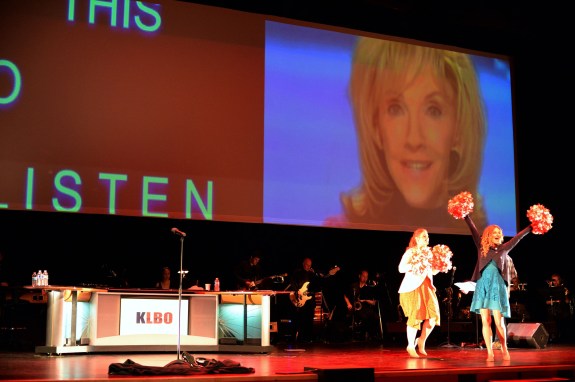
The opera takes place on the set of a news broadcast (the station is dubbed KLBO here) with two anchors, both female, both good looking in a dolled up anchor kind of way. The anchors initially sit behind a desk, as the production crew mills about, the broadcast about to begin.
What ensues proves not unrecognizable in form. “The News” is a mixture of “The Daily Show” and Steve Reich, of Michael Moore and pop music and absurdist theater. A wide screen stretches about the stage and upon it are screened a series of news segments (we see Trump right off), found objects from the mainstream media.
JacobTV slices and dices the spoken phrases therein, repeats them and turns them into little rhythmic riffs, the tonal inflections becoming melody. A nine piece band at the rear of the stage — including a saxophone choir, trumpet, trombone, percussion, electric guitar and bass — takes up the riffs and generally turns them into a cheerful thrum of pop, jazz and minimalism. The band is ably conducted by Andreas Mitisek, general director of the company and here doubling as a producer of the news broadcast.
Our two anchors (Loire Cotler, who specializes in rappy, rhythmic patter, and Maeve Hoglund, who introduces a soaring lyricism) interact with and echo the video segments, cavorting all the while like a pair of Mick Jaggers, slowly disrobing as the opera proceeds, both eventually doing the news with fake breasts exposed.
The point of it all is not just that the news is bad and that the human race is a tribe of idiots (though that seems clear enough) but that the way the media covers it all is nothing but a gigantic joke. (Strangely, Fox News clips were used sparingly.) Thus the ironic party atmosphere encouraged by the anchors.
What’s more, JacobTV intersperses the jokey real news segments with episodes in a more documentary style, with real people (not talking heads) talking about their plights in, say, Syria and Somalia. These minor-keyed numbers are often quite haunting in mood.
The one flaw in the performance — and this listener considers it a major one — was the sound design. Perhaps this kind of multimedia extravaganza is ultimately unperformable, mixing as it does live music with video sound, amplified instruments with acoustic, and operatic voices singing into microphones. At any rate, one understood perhaps one in ten words sung and the musical textures were muddy, monochromatic and over reverberant.
In the end, “The News” unwinds as a number opera, 32 music videos, like a Handel opera for post-modern times. It would benefit from cuts — most points were made several times — though all of the music is entertaining enough and director Tanya Kane-Perry keeps everything moving along in a lively manner.
You do feel your heart sinking as the opera proceeds, however. “The News,” I’m afraid, is also depressing.
photo: Keith Ian Polakoff


 Classical Life