Chicago Symphony tonight

Conductor Chris Russell, a friend of Classical Life, will host the pre-concert talk tonight at 7 p.m. He’ll be interviewing the composer Mason Bates, whose new “Alternative Energy” we’ll hear Riccardo Muti and the Chicago Symphony perform.

Bates participates in the performance of “AE,” by the way. He operates the electronics from a computer keyboard.

There has been some discussion about the program. Not many correspondents seem to have heard Honegger’s “Pacific 231” in live performance. It is a rarity. As it happens, I have heard it live, at the Dorothy Chandler Pavilion conducted by David Zinman. I think it was the Baltimore Symphony, but it may have been LA Phil. At any rate, I was young and stoked about it, and purposely timed my very loud bravo for the moment of silence between the last chord and the applause. Many months later, I was driving around in my car and there was a recording of “Pacific 231” on the radio. When it ended, I heard a loud “Bravo!” followed by applause. It was the performance I had been at.

Also, a couple of people say that they’ve never quite warmed to Franck’s Symphony, which closes tonight’s program. I had the same feeling, until I heard the recording made by the Chicago Symphony and conductor Pierre Monteux. I’ll wager it will convince you as well. It’s in my recommended recordings.

Finally, I’d like to pass along a very satisfying moment in my interview with Muti, which didn’t make it into the article. We were talking a little bit about “Pacific 231” and I asked him if he had ever heard “Rugby” by the same composer. Muti said he knew the title, but had never heard the piece. So, I told him it was a very interesting piece and it was a kind of sequel to “Pacific 231.”

“Ah, so I will look at,” he said. “Maybe next time I will bring to you. … Thank you for telling me this.  I will ask immediately for a librarian to bring me the score.”

I have since been informed by the Chicago Symphony that Muti does indeed have the score to “Rugby” in hand. How cool is that?

The recording of “Rugby” (above) is by Leonard Bernstein and the New York Philharmonic.
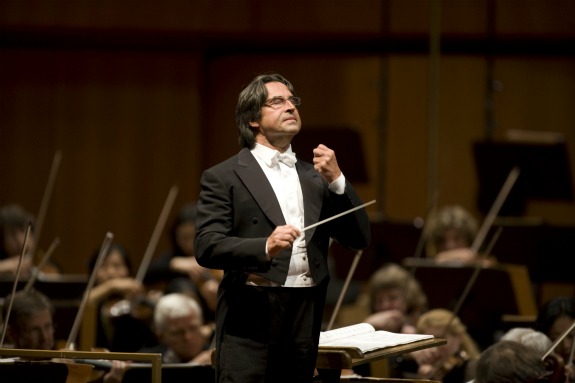
Riccardo Muti explains (away) conducting

Not sure that I agree with him — I think it is important, and not just window dressing, for a conductor to inspire an orchestra — but Muti does have a point. Conductors should at least try not to overdo it.

Riccardo Muti: A maestro despite himself

Here’s my interview with conductor Riccardo Muti, who brings the Chicago Symphony to California next week.

photo: CSO/Todd Rosenberg

Los Angeles Philharmonic announces 2012-2013 season

Click here to view a PDF that gives a chronological list of events in Walt Disney Concert Hall.

Pacific Symphony announces 2012-2013 season

Click here to read my article. Be sure to click through the slide show to see all the programming details.

Muti conducts Mozart

With Riccardo Muti at the helm, the Chicago Symphony will visit Orange County for the first time in a couple of decades on Feb. 17. I thought I’d share a Muti video or two in the next couple of weeks and perhaps something of the Chicago Symphony as well.

In this video, Muti conducts the Vienna Philharmonic in a 1999 performance of the Overture to “The Marriage of Figaro” by Mozart.

I’ll share an interview with Muti in a few days.

Not incidentally, Muti and the Chicagoans will perform a boffo and unhackneyed program here consisting of Honegger’s “Pacific 231,” Mason Bates’s “Alternative Energy” and Franck’s Symphony. Hallelujah.

Benedetti debuts with Pacific Symphony

In today’s Orange County Register online, I review violinist Nicola Benedetti and conductor Christoph Konig performing with the Pacific Symphony.

Click here to read my review, or pick up a copy of tomorrow’s newspaper.

Yet another intro

The artistic purpose of this little introduction to our weekly celebrity slideshow is twofold: to fill up space and to get you, dear reader, to click on the slideshow.

The first purpose (filling up space) is really quite simple to accomplish. You type stuff. Longer words are better (because they fill more space), which is to say that they are superior (in filling more space) than shorter words (which are shorter, and fill a smaller space when compared to the longer words).

Yammering helps. Just about any subject will do. Like, for instance, the Blake Griffin dunk. Wow, did you see that? Man! If you haven’t seen it you should really look it up on YouTube. Gee whiz! How does he do that? Come on! He posterized that dude! The dude he posterized must have been thinking, “What the … ?”

That’s yammering.

Click here to see the Most Outrageous Celebrity Antics of the Week

But there is also an aesthetic element to filling up space, if we may use that word (“aesthetic,” we mean). Imagine, if you will, a blank spot where these words are right now. Imagine this entire page without words. It wouldn’t look very good, would it?

So, we type stuff.

The second purpose, however, is a little trickier. Getting readers to click on the slideshow (where the rubber really hits the road) is a subtle craft. You must not give anything away about the upcoming slideshow, keeping the reader curious. No spoilers in the introduction is Rule No. 1. At the same time, you must imply that the upcoming slideshow is really worth the reader’s while, that’s it’s a great way to spend the next few minutes of his life even if he’ll never get them back.

As we say, it’s a subtle craft. We may not be up to it. The greatest artists of all time wrestled with this imperative. Perhaps Johann Sebastian Bach handled it best. He composed these things called fugues, and they were really something else. If the 18th century could be said to rock in any way, Bach’s fugues were rock central. But he had a problem. “How can I get people to listen to my fugues?” Bach asked himself, especially when they have so many other fun things to distract them, like shoveling horse manure and plucking the chicken for dinner.

Bach came up with this solution: He wrote preludes to the fugues. These preludes “teased” the fugue, got listeners wondering what was next, put them in the frame of mind, almost like magic, to listen to a fugue. You could say that these preludes almost made the listeners hunger for a fugue. And that’s just when Bach would spring a really rockin’ slideshow on them.

OK, we typed enough.

Click here to read the Most Outrageous Celebrity Antics of the Week

Too much conductor, not enough cow bell

Uh, this is pretty ridiculous. Was he drinking? The piece is “What’s the Use?” from Bernstein’s Candide.

Hat tip to Tim Smith at Clef Notes.

UPDATE: Darn, they took the video down.

UPDATE: It’s back.

Violist responds to cell phone interruption

This is one way to handle it …

Related post:

10 ways not to have your cell phone ring during the softest part of a Mahler symphony
