As I should have mentioned earlier, I’m on a short hiatus from posting on this blog, and the hiatus will last a few days more. I’m glad to see you are all getting along quite nicely without me in the meanwhile.
Ojai Music Festival live video streaming
 The Ojai Music Festival is offering live video streaming of its concerts this weekend, free of charge. Go here.
Here’s the schedule of the streams:
Saturday Morning Concert – 6/9 at 11:00 AM
Saturday Evening Concert – 6/9 at 8:00 PM
Sunday Morning Concert – 6/10 at 11:00 AM
Sunday Evening Concert – 6/10 at 5:30 PM
The two concerts already performed on Thursday and Friday are here. You can sign up for reminders for the concerts you’d like to hear.
There’s lots of good and unusual music on tap. Norwegian pianist Leif Ove Andsnes is the music director this year. His guests include the Norwegian Chamber Orchestra and pianist Marc-Andre Hamelin.
George Washington Bicentennial March
We were surprised to find, of all things, a march by John Philip Sousa on The Rest is Noise the other day. We had no idea that Alex Ross was a fan of The March King. It’s a nice one, called “The Transit of Venus” March, and performed by the Staff Band of the Westgroup Russian Forces in Germany. Here it is.
Mr. Ross gives me the chance to share one of my favorite Sousa marches, namely “The George Washington Bicentennial” March, written at the end of his career. I like the whole thing, but the third strain (or trio) is especially fine.
You’ll find a recommendation for an exceptional recording of Sousa marches in my recommended recordings. Why is it that Communists played Sousa so well?
Review: ‘The Gospel According to the Other Mary’

Click here to read my review of John Adams’ new oratorio, The Gospel According to the Other Mary, performed by Gustavo Dudamel and the Los Angeles Philharmonic on Friday night in Disney Hall. San Francisco Classical Voice, June 1, 2012.
Other reviews:
Beethoven: 9
In today’s Orange County Register online, I review a performance by Carl St.Clair and the Pacific Symphony of Beethoven’s Symphony No. 9.
Click here to read my review, or pick up a copy of tomorrow’s newspaper.
Fussell, Fischer-Dieskau, Gibb

It irks me how the deaths of these three men recently have been treated in the media.
Paul Fussell died in the last week. Admittedly, I haven’t seen all the coverage. The New York Times had a short obituary of him that left a lot out, including mention of one of his major books, “Class,” a brilliant, maddening, politically-incorrect and hilarious exploration of the American class system (yes, there is one) that I count among the most life-changing books I’ve ever read. News of Fussell’s demise has been a mere blip on the media’s radar as far as I can see (ArtsJournal doesn’t even have an obit) and he’s a major author. His masterpiece is “The Great War and Modern Memory,” winner of a National Book Award and a must-read for anyone interested in the seeds of Modernism. A number of his other books are worth checking out as well, including “Wartime,” “Samuel Johnson and the Life of Writing,” “Bad, or, The Dumbing of America” and “The Anti-Egotist: Kingsley Amis, Man of Letters.”
I don’t want to make too much of this. My evidence is anecdotal, based on my own perusing. These days, you can find the information you want if you go looking for it. Somewhere, a writer is probably working on a massive appreciation of Fussell. Still, one wants to see a big deal made out of him in the newspapers and other mainstream media.
As with Dietrich Fischer-Dieskau. I was driving home from work when “All Things Considered” mentioned his death prefaced with an apology for doing so. Robert Segal came on and said “But first, we must make a brief mention of an opera singer who died this weekend” or something along those lines, assuring the listener in tone and words that “ATC” has to get this out of the way and they’ll make it as painless as possible. The memorial was indeed brief, including just a short snippet of Fischer-Dieskau singing, and pretty much boilerplate.
Meanwhile, the Los Angeles Times was aghast at the death of Bee Gee genius Robin Gibb, as if he were some sort of colossus of 20th century music. The same day they devoted pages to Gibb’s death, Fischer-Dieskau’s was noted in a single column obituary, in the secondary notices. Is it just me, or is Fischer-Dieskau at least the artistic equal of Gibb?
Believe me, being a journalist, I know why this kind of thing happens. I still don’t like it.
Review: Dudamel’s ‘Don Giovanni’ at Disney Hall
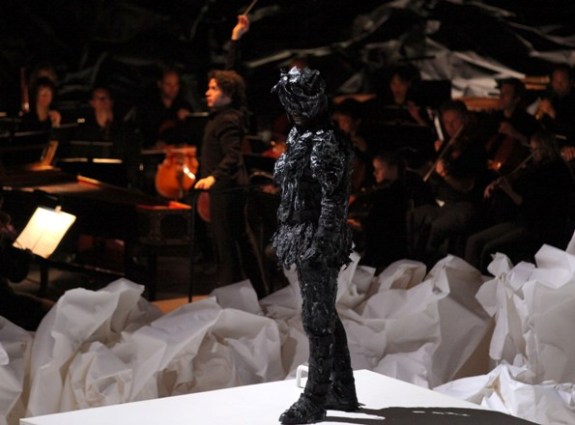
Limited time offer: Musical America is now offering a FREE link to my review of the Los Angeles Philharmonic’s production of “Don Giovanni,” conducted by Gustavo Dudamel, with sets by Frank Gehry and featuring a starry cast.
Don’t know how long it’ll be up, so CLICK NOW!
Photo Credit: Craig T. Mathew/Mathew Imaging.
Jonas Kaufmann lip syncs in Munich while on sick leave from the Met
The tenor confesses on Facebook. Click here to read my story.
Old favorite — Sonny Boy Williamson
Because I like it.
Short-sighted
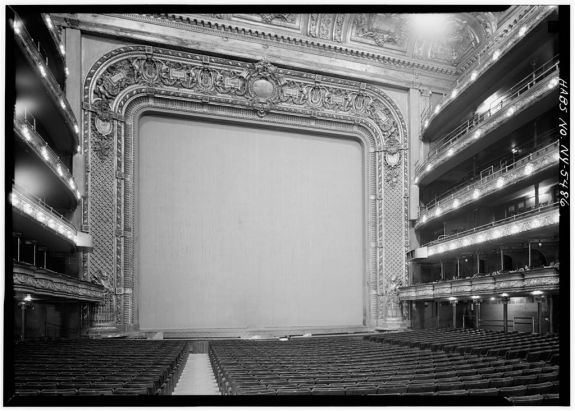
The big story today is that Opera News, which boasts the largest circulation of any classical music magazine in this country, will no longer review the Metropolitan Opera. Opera News is published by the Metropolitan Opera Guild, a support group for the company, so you might think this is about conflict of interest, but no. It’s because the Met’s general manager, Peter Gelb, didn’t like the lambasting the magazine was giving to the company’s widely excoriated new production of Wagner’s Ring cycle.
Click here to read the New York Times article.
I hope that saner minds will prevail.
UPDATE (from Met Opera press release, via Alex Ross):
“In view of the outpouring of reaction from opera fans about the recent decision to discontinue Met performance reviews in Opera News, the Met has decided to reverse this new editorial policy. From their postings on the internet, it is abundantly clear that opera fans would miss reading reviews about the Met in Opera News. Ultimately, the Met is here to serve the opera-loving public and has changed its decision because of the passionate response of the fans.
“The Met and the Met Opera Guild, the publisher of Opera News, have been in discussions about the role of the Guild and how its programs and activities can best fulfill its mission of supporting the Metropolitan Opera. These discussions have included the role of reviews in Opera News, and whether they served that mission. While the Met believed it did not make sense for a house organ that is published by the Guild and financed by the Met to continue to review Met productions, it has become clear that the reviews generate tremendous excitement and interest and will continue to have a place in Opera News.”
Wow, saner minds did prevail. I didn’t know that happened anymore.
Support Classical Life

Classical Life

 Classical Life