Anger management and Mahler’s 3rd

The trombone solo in the first movement of Mahler’s Third Symphony is one of the best there is for the instrument in the symphonic repertoire. It’s lonely and fierce, sad and exposed. It’s also pretty difficult to play. It may sound simple, but you have to get the maximum sound out out of the horn while still maintaining a rich tone, which is one of the hardest things to do. As a trombonist myself, I feel chills whenever I hear the solo. The fellow in the video above does a dandy job of it.

I wasn’t always so lucky. I never had the good fortune of playing this solo with a full orchestra in performance, but back when I was at USC, we trombonists practiced it incessantly as an orchestral excerpt. These excerpts are played by every instrument — violinists practice the first movement of Mendelssohn’s “Italian” Symphony, for instance, or the opening of “Don Juan” — in preparation for orchestral auditions, where you are invariably called upon to play them.

Trombonists play things like the storm sequence in the Overture to “William Tell,” the fourth movement of Schumann’s “Rhenish” Symphony, the “Bolero” solo (the most difficult of any solo in the piece, by the way) and the solo in Mahler’s Third. At USC, the members of the trombone class would practice them and our teacher, Terry Cravens, would set up “mock auditions,” during which we’d each play through them in turn. Cravens and a couple of other volunteer musicians would serve as jury, with their backs turned toward us, just as in the blind auditions for orchestras. They’d score each trombonist’s performance and at the end we’d find out our ranking. Needless to say, competitive feelings ran high.

Most of us got nervous during these mock auditions; I certainly did. But then that was the idea. You have to learn to play when you’re nervous, or you’ll never win an audition. You have to learn to control your nerves, if you can.

The interesting thing about nerves is that they affect the muscles or body parts that you intend to use in whatever you’re trying to do. A cellist doesn’t suffer from dry mouth, a singer does. I don’t imagine a harmonica player worries much about wobbly knees. My problem was with my lips, or embouchure. They (or it) quivered, making it difficult to hold a steady tone. The challenge was to remain calm, to fool yourself into thinking it didn’t matter that much, so the lips wouldn’t shake.

The trombone solo in Mahler’s Third begins with two long tones on A, played loudly, with a breath in between. In the mock audition in question, probably in my junior year, I nailed the first one. On the  second one, however, my lips shook and I couldn’t focus my embouchure on the tone and I ended up blasting a huge splat. Really ugly and blatant. With all the other trombonists sitting around, and the jury with their backs to me, it was embarrassing. My immediate response was anger, hot, livid and adrenaline-pumping anger. “Shit!” I said to myself, or something like it, and I lost all composure, or what little of it I had had.

What happened afterward I’ll remember for the rest of my life. I laid into that solo in pure rage — not meaning to, but tapping into my volcanic anger to the utmost. I didn’t care what happened, I didn’t think I was even playing well. I blasted my way through the solo with what I felt at the time was an inappropriate vehemence, expending my rage into the music. I knew I had already failed, so it didn’t matter.

The jury loved it. The splatted second A didn’t bother them, given what followed, which fairly blew the roof off the joint. I was surprised. The exact outcome is foggy in my memory, but I think I received the highest score of all the trombonists on the Mahler excerpt and came in second overall to an awesome, older trombonist we all envied and admired. It was, for me, a moment of arrival.

I’m not sure what lesson there is here. Perhaps that calm and poise are overrated when it comes to performing music, though I admire those attributes in a musician. For that brief span, though, when I was playing that Mahler Third excerpt, I lacked those qualities utterly, and it came across to the audience vividly. Give it your all, don’t be careful, might be the moral. I’m suspicious of morals, though. Might not it have been better had I hit that second A? Well, I wouldn’t have a story.

The summer of ’79

I spent the summer of 1979 practicing. At this time of year my thoughts often go back to those months. Other summers run together in my memory, but I always know what I was doing that summer.

I had just finished my freshman year as a music major at the University of Southern California. It hadn’t gone as well as I had hoped it would. I aimed to do something about it.

As a trombone player in high school I had been pretty hot stuff. I had moved up in the ranks to become section leader of our large, award-winning school band, as well as in our orchestra and jazz ensemble. I was first trombone in the All Southern California High School Honor Band, then first trombone in the All Southern California High School Honor Orchestra. I was taking lessons from a teacher at Long Beach State. I auditioned for and made a small, elite high school jazz group headed by Art Bartner, the longtime leader of USC’s marching band, and, one thing leading to another, ended up with a full scholarship to study music at USC.

You know where this is going. Arriving at USC in the late summer of 1978, I immediately found myself at the bottom of the heap of some 12 to 14 other trombone majors, most of them older than me. It didn’t help that during the rigorous marching band boot camp run by Bartner  — outdoors, in heat, dust and smog, prior to the official start of the school year — I suffered a severe asthma attack. I had had asthma since I was child, and you don’t get over such attacks right away. This one stayed with me with me through the first auditions of the semester, during which we were placed in various performing groups. Not wanting to make excuses, I arrived and played for the first time for my new teacher, Terry Cravens, without telling him of my affliction. I remember he had me play “The Ride of the Valkyries,” a piece I had shockingly never so much as seen before and in five sharps to boot. I couldn’t play it. I couldn’t breathe.

Cravens subsequently found out what was going on and things sorted themselves out, but I ended up near the bottom of the trombone class, with the consequent performing assignments in the bottom-rung ensembles, playing second or third trombone parts. It wasn’t what I had envisioned.

Jump ahead to the end of my freshman year. I believe it was Cravens who gave me the idea of practicing eight hours a day. I don’t think he prescribed it; he told me about someone who had done it. At any rate, I decided to do it. I didn’t have a job during the summer of ’79. And as chance would have it, someone asked me to house sit that summer. So I lived by myself and practiced eight hours a day — I think six days a week, and I think for three months. I even blew off the “Tusk” recording session the USC Marching Band had with Fleetwood Mac that summer in Dodger Stadium. I felt it was beneath me, I’m sorry to say.

I would begin each day with an hour or more of warm-ups and flexibility exercises, long tones and arpeggios quickly flipping between registers. Sometimes I went in for extended periods of long tones alone, which became like meditation. Cravens had told me that if you just played long tones long enough, focusing your embouchure just right, you would actually be able to hear sympathetic overtones ringing high above your note. So, if you played an E flat, say, in the middle of the bass clef, for 10 minutes, you could hear a high G glowing like a halo above. Then you might move onto the E natural. Anyway, I did it.

I practiced etudes, orchestral excerpts (including “Ride of the Valkyries,” “Bolero,” “William Tell,” Beethoven, Brahms, Mahler, etc.), Bach cello suites and bel canto singing exercises (Rochut’s famous, or infamous, “Melodious Etudes for Trombone”). I watched the clock. Took breaks. Ate lunch and got back to it. Occasionally, during periods of pure rote practicing, I might flip on a baseball game with the sound off, and watch as I played (I had heard Itzhak Perlman did this.) But I put in my eight hours faithfully. Afterwards, friends came over for cards. We played Hearts and drank beer.

The upshot of my summer of practicing is that when I got back to school in the fall of ’79 I was vastly ahead of where I had been. I was no longer at the bottom of the trombone heap. I was someone who could compete, someone to pay attention to. Most importantly to me, my performing assignments improved. Chalk it all up to lots of practice. And you know what? It was kind of fun.

Photo: The author with beer in 1979. Photo by Mark Osborn.

Esa-Pekka Salonen carries the Olympic Torch

Esa-Pekka Salonen carries the Olympic Torch from Philharmonia Orchestra on Vimeo.

This happened in London today. The LA Times has a story. Great to see our old friend, don’t you think?

Wonder if he had a glass of this afterward.

Shostakovich: Piano Quintet in G minor, finale


I just listened to this piece for the first time in a few years, sitting down in front of my stereo after dinner. It was very civilized, especially with a Guinness Stout in hand. I have the recording with Richter and the Borodin Quartet (I should put it in Recommended Recordings). But here’s Glenn Gould and an uncredited string quartet (probably the Symphonia Quartet) playing the finale. Note that Gould is playing from memory, an unusual and unorthodox thing to do in chamber music.

Photo: Enrico Caruso boards the ‘Giuseppe Verdi’

I ran across this photo the other day and just thought I’d share it: Enrico Caruso boards the good ship “Giuseppe Verdi” con gusto. Click on the image for a larger view.

The “Giuseppe Verdi” was built in Italy in 1914, and it did passenger service between Italy and New York. In 1928, it was sold to Japanese owners and renamed the “Yamato Maru.” It was sunk by a U.S. submarine in the Philippines in 1943.

Below, Caruso sings ‘Vesti la giubba’ from Pagliacci. Have a hanky ready.

Blogroll addition: Emphasis Dance

I’ve added Emphasis Dance — a new blog from my good friend and former colleague at the Register, dance critic Laura Bleiberg — to the blogroll. You see Laura’s name in the L.A. Times often these days.  Go over to Emphasis Dance and welcome her to the blogosphere.

Domingo and L.A. Opera to bring ‘I due Foscari’ to O.C.

Placido Domingo and L.A. Opera will brave a trip down the 5 freeway into the darkest wastelands behind the Orange Curtain to present a concert performance of Verdi’s I due Foscari.

Click here to read my article in the O.C. Register

Classical Life turns 2

At some point on Sunday, July 15, 2012, Classical Life, as this blog is known, turned two years old. The exact hour of the occurrence is unknown and lost to history. No champagne corks popped, no fireworks launched, no streamers streamed. It was a rather sad occasion, actually, because no one even remembered. “Full many a flower is born to blush unseen” and all that. No, no, don’t say it, we’re fine.

Nevertheless, we thank our faithful readers for their manly support and unflinching patience. We’d be nothing without you, dearest blognescenti.

Here’s looking forward to the terrible twos.

Summer reading

I’ve never quite understood the concept of “summer reading.” On the one hand, it appears to denote a certain kind of book, a page turner, a thriller or some sort of light material suitable for reading on the beach, as if we all spends days and weeks there in the summer months, and don’t read these types of books at any other time of the year. On the other hand, as when various worthies broadcast their summer reading lists, it seems to imply a getting down to brass tacks kind of study, of finally sitting down and consuming all of  “The Decline and Fall of the Roman Empire” or “Don Quixote” or “Ulysses” because it’s good for you and since you’re a professor you have the summer off from your rut of a job. But never mind and at any rate, here are the two books I currently have my head in and I really don’t know what the season has to do with it.

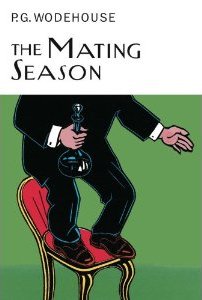
“The Mating Season” by P.G. Wodehouse. It has the reputation of being one of the best, if not the best, of the Jeeves and Wooster novels, but then, don’t most of them? It’s definitely a pip, though, and Wodehouse seems on a roll. The prose glides off his pen. I’ve rediscovered something while reading it, too (I’ve read a lot of Wodehouse). It is best to read his books at a certain pace, not too fast, not too slow … but definitely not too fast. Here’s the opening of the book, which requires a certain tempo (Bertie Wooster, as always in the Jeeves and Wooster stories, is the narrator):

While I would not go so far, perhaps, as to describe the heart as actually leaden, I must confess that on the eve of starting to do my bit of time at Deverill Hall I was definitely short on chirpiness. I shrank from the prospect of being decanted into a household on chummy terms with a thug like my Aunt Agatha, weakened as I already was by having her son Thomas, one of our most prominent fiends in human shape, on my hands for three days.

I mentioned this to Jeeves, and he agreed that the set-up could have been juicier.

‘Still,’ I said, taking a pop, as always, at trying to focus the silver lining, ‘it’s flattering, of course.’

‘Sir?’

‘Being the People’s Choice, Jeeves. Having these birds going around chanting “We Want Wooster.”‘

Now, if you just skimmed that or read it too fast (as people do when reading blogs), you will have missed the best part, the mot justes (if that’s the word I want) that give the passage not only a quality that defines the character of the narrator (a lovable upper crust boob) but its zing. I give you chirpiness, decanted, thug, fiends, human shape, juicier and chanting, among others.

Read more…

Campoli plays Monti’s ‘Czardas’

The wonderful Italian-British violinist Alfredo Campoli (1906-1991) plays Monti’s “Czardas.” Sure, it’s candy, but beautifully done.

I’ve only recently discovered Campoli. I have a terrific recording of him performing the Tchaikovsky Violin Concerto that I actually listen to on purpose. It’s right up there with Oistrakh’s recording, in my opinion.