Review: Long-neglected music gets a fresh L.A. Phil spin at the Hollywood Bowl. The Los Angeles Times, Sept. 7, 2016.
Great moments in film music: ‘Yojimbo’
Electric guitar and harpsichord, major vs. minor and heavy percussion. Music by Masaru Sato (and worthy of Ennio Morricone). The opening titles to “Yojimbo” (“Bodyguard,” remade as “A Fistful of Dollars”), directed by Akira Kurosawa and starring Toshiro Mifune.
Great moments in film music: ‘The Third Man’
Closing sequence. Zither music played by Anton Karas.
Great moments in film music: ‘North by Northwest’
Titles by Saul Bass. Music by Bernard Herrmann. Watch for Hitchcock at the end — he misses the bus.
Bartok: Piano Concerto No. 2, – 1. Allegro
Maurizio Pollini, piano. Claudio Abbado conducts the Chicago Symphony Orchestra.
Great moments in film music: ‘The Big Country’
Opening titles by Saul Bass, music by Jerome Moross.
Great moments in film music: ‘Once Upon a Time in the West’ (The Duel)
Music by Ennio Morricone, of course. Notice the play of major and minor harmonies, worthy of Schubert. The clip ends, appropriately, in pure dissonance.
Elegy for a record store
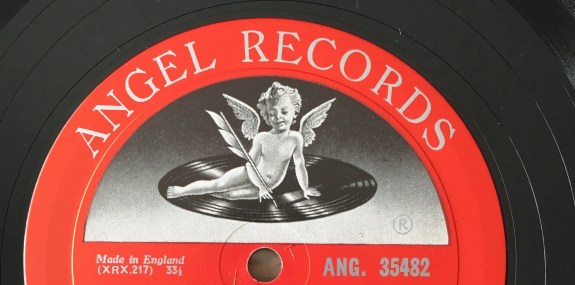
[From the archive, first published in 2006.]
I remember the day that the woman walked into the Tower Records I worked at — the classical annex on Sunset Boulevard in L.A. — and asked me for the best record in the store. I got a little snooty with her, like Jack Black in “High Fidelity.”
I told her that “these aren’t hamburgers,” you can’t say which one is the best. I offered to show her some good ones, and let her decide. I recall that I ended up selling her Carlo Maria Giulini’s recording of the “Eroica” Symphony. I hoped it would change her life.
Clerking at Tower Records for two summers in the mid-’80s (between stints at grad school) was an education in itself. Your customers ran the gamut from dimwits to seasoned connoisseurs, many of whom came in for their regular fix (stacks of records) and stayed to chat. My fellow clerks were also endlessly knowledgeable (for kicks, we’d open up several different recordings of the same piece and debate their merits) and a few of us even went on to bigger (though maybe not better) things. Mark Ringer, the author of a recent, lauded guide to Monteverdi, was one such colleague.
The death of Tower Records (bankrupt, liquidated) is a serious blow for classical music. With the disappearance of the independent dealer, Tower became the most reliable and comprehensive source for classical-music recordings over the past few decades. According to The New York Times, Tower alone accounted for perhaps as much as 50 percent of all classical record sales. It’s not easy to imagine how the store will be replaced.
Browsing is important — absolutely necessary — for the classical buyer. I saw it firsthand. Often, customers didn’t have much of an idea what they wanted when they walked in the door. Often, even if they did, it was a piece of repertoire, a recording of “The Magic Flute,” say, or of “The Four Seasons,” not a specific recording. Which one of the dozens offered they didn’t know; they’d browse and find out, often with our help.
And while they were at it, they’d see other things. Ah, a new Pollini recording they hadn’t heard about, a newly restored Klemperer re-issue, a live recording never before released of Callas singing Bellini. You browsed, you discovered. Who knew Tchaikovsky wrote a seventh symphony (the “Manfred”)? You weren’t likely to find out about any of these recordings, and most others, unless you browsed.
Having a knowledgeable clerk on hand is also crucial to the classical-buying process. This is not only so for the novice listener. A knowledgeable clerk (record stores don’t always have them, but Tower had its fair share) knows his stock, knows what’s best, knows the deals. With its vast back catalog comprising a history of Western music stretching back to the Middle Ages and even earlier, classical recordings require a music-critic guide at ground level — the knowledgeable record clerk.
At the Laguna Hills Tower Records, that was my friend Charlie Brand, who knows more about classical recordings than just about anyone I’ve ever met, including myself. I relied on his advice, and he never let me down. (Thanks for turning me onto Maxim Vengerov, Charlie).
You just can’t browse online like you can in a record store. And downloading doesn’t cut it with many (most?) classical fans. (You download “Gotterdammerung.”) In this way, you might say that classical recordings are like hamburgers.
Nathaniel Pierce plays and sings Schubert
Ah, the joys of the student recital. The songs are “Das Wandern” and “Der Erlkonig.”
10 ways not to clap after every single song at a Kathleen Battle recital
[From the archive.]
The following list is offered as a public service.
10. Don’t clap until Kathleen Battle commands you, by royal decree, to clap.
9. Buy two tickets for $250 each to the recital. Leave them in the back pocket of your jeans. Launder according to instructions.
8. You’re on your way to the concert when you realize that you left the back burner on, the one that smokes all the time. You turn around and go home and find your teenager having a wild party in your absence. Rather than get mad, you join him.
7. Wait until you hear “O mio babbino caro.”
6. Go to True Value Hardware. Buy a packet of 5-inch nails. Insert nails between each finger, with the sharp points facing the opposite palm. Attend recital as usual.
5. One word: Handcuffs!
4. Clap only when the “Applause” sign is lit up.
3. Clap only when Battle is singing.
2. Bring your cell phone to the concert. As the concert begins, call your health-care provider with a question about your coverage. Listen to your phone-tree options, press the one you want. Wait.
1. Order the chicken salad and hold the toast — between your knees!
Support Classical Life

Classical Life

 Classical Life