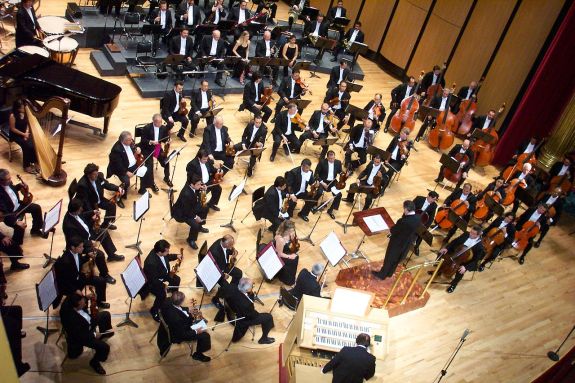
The New York Philharmonic, Aaron Copland, conductor. This taken from a Young People’s Concert.
The New York Philharmonic, Aaron Copland, conductor. This taken from a Young People’s Concert.
00:00 Sonata in C major, K. 72, L. 401
02:22 Sonata in A-flat major, K. 127, L. 186
08:11 Sonata in F major, K. 525, L. 188
10:35 Sonata in D minor, K. 9, L. 413
13:55 Sonata in C major, K. 159, L. 104
16:01 Sonata in D minor, K. 1, L. 366
18:05 Sonata in G major, K. 259, L. 103
21:56 Sonata in E major, K. 20, L. 375
24:40 Sonata in B major, K. 245, L. 450
28:38 Sonata in C major, K. 132, L. 457
33:55 Sonata in D minor, K. 141, L. 422
Danièle Duchenne, piano.

The Iceland Cometh to the Los Angeles Philharmonic these days, specifically in the form of what would seem an unlikely Reykjavík Festival, a wide ranging exploration of the contemporary music scene in the Nordic capital running April 1 to June 4. The offerings range from Bjork (in digital form) and Sigur Rós (live) to, well, a bunch of ostensibly classical composers you’ve never heard or heard of. Perhaps that’s the point: It’s time we did.
I ventured up to Disney Hall on Saturday night to hear a program dubbed “Sigur Rós III” that featured the artsy post-rock band in collaboration with the Philharmonic and none other than Esa-Pekka Salonen. The orchestra and Sigur Rós were basically doing their thing for the third night in a row, but the substantial prefatory material was different.
What a crazy and ingenious idea for a concert. The hall was filled with an unusually young and hipster crowd, Sigur Rós fans, make no mistake. Having this captive audience, the Philharmonic took a page from the Boston Pops, fiddled with it and performed a set of bristling Icelandic music — medicine, so to speak, to help the sugar go down. Judging from reactions, it seemed to work.
I was most curious to hear the Organ Concerto by Jon Leifs (1899-1968), one of the greatest Icelandic composers but rarely encountered on these shores. Leifs himself has an interesting story that I won’t get into here, but a highlight (or lowlight) of it involves this very concerto, performed in Nazi Germany by the Berlin Philharmonic in 1941. Leifs was living in Germany at the time, but this furiously dissonant concerto, written in 1930, put him permanently on the outs. He left for Sweden, with his Jewish wife, in 1944.
Leif’s concerto opens with a series of tone clusters blasted by the organ, vigorously answered by caustic brass and thundering timpani, an assault. A passacaglia (repeating bass line) ensues, all twelve chromatic tones in it, a glowering thing. There are 30 variations over the passacaglia theme, slowly building to a couple of ear shattering climaxes. The regularity of the bass line brings order to an otherwise cacophonous world. The coda arrives and Leifs uses it to reiterate cadential formulas, which seem to duke it out for a victory that never arrives.
The piece’s length — only 20 minutes — adds to the impression; the listener feels as if he’s been grabbed by the neck and given a good shaking. Organist James McVinnie played the solo as if he were Homer Simpson chowing down a meal (and he, unfortunately, did outgun the orchestra a little too often) and Salonen and the orchestra answered in kind. Somehow, it was great fun.
The concert opened with Leifs as well, a brief a cappella Requiem (vacillating suddenly between major and minor, drone-filled) sung by the 18 singers of Schola Cantorum Reykjavik, led by Hördur Askelsson. At least I’m pretty sure it was the Requiem. The house was too dark to follow the words and the program listed five pieces to be performed by the Schola, but only four were. At any rate, it’s a tight, well balanced group, and the other generally folksy pieces were a delight as well.
Salonen then led the U.S. premiere of Maria Huld Markan Sigfúsdóttir’s “Aequora,” a pretty and sparkling soundscape (no faint praise implied) that sounded as if it were a mash-up of the beginnings of Mahler’s First and Strauss’s “Alpine” symphonies with the Prelude to Act I of “Lohengrin” thrown in.
It served as a fitting intro to the spacious world of Sigur Rós, though the organ concerto and intermission came first. Sigur Rós, now a trio, performed a set of songs with the orchestra, the arrangements by the likes of David Lang, Nico Muhly and Missy Mazzoli (real classical guys, in other words). In the heavily amplified sound environment these arrangements seemed no great shakes, mostly just the typical symphonic filling out that orchestras are called to do for rock bands, though tasteful in this case. Salonen waved his arms efficiently, and exacted detail when necessary (which was occasionally).
Sigur Rós did its thing, which sounded like the music you might listen to in an isolation tank in rotation with the calls of humpback whales. One song sounded like the theme to “Mystery Science Theater 3000” (the version at the end of the show) slowed down for the sake of profundity. From what I understood (which was nothing) everything was sung in either Icelandic or a made up language called Vonlenska, which is like Klingon on sedatives. No texts were provided.
In other words, it wasn’t so bad if you like this sort of thing. Salonen and the L.A. Phil then took off, so did I, and Sigur Rós and fans stayed for another set. They may still be there now. I really do like the idea of a symphony orchestra opening for a rock band, though.

What can be done to save music criticism? In the twilight of the mass media as we know it, there seems nowhere for it to turn. Only the big city papers are able to support full time music critics anymore, and even then the record is spotty. California has but two full time music critics. The country has less than ten. Recently in The New Yorker, Alex Ross painted a bleak picture of the current state of the profession. It was accurate.
Freelancing is not the answer. Not only is there insufficient work to be had, but the pay is horrible, not to say insulting. (I’ll refrain from quoting rates.) What’s more, a freelancer gets no benefits, no healthcare. These days, freelancing turns music criticism into little more than an interesting hobby.
I believe the way ahead for music criticism is to put it on the same basis as the art form which it covers, which is to say non-profit. Every single symphony orchestra, opera company and chorale, and most if not all chamber groups, are non-profit organizations, like museums. Until recently, music criticism has been happily and vigorously supported by for-profit companies, i.e. newspapers. As newspapers sink under the weight of their own mismanagement and myopia, the powers-that-be no longer see a way to do so.
There are a few ways that music criticism could become non-profit. One is for the music critic to establish him or herself, and his or her website, as a non-profit corporation, or 501(c)(3), and then start raising funds from donors and looking for grants from foundations. (I could take your money here, but I’m not a non-profit, so I couldn’t attract large donors who wanted a tax break.)
An easier way is to get a local non-profit to act as your fiscal sponsor. That is, the non-profit (say, Arts OC), accepts the money from donors and grantees (which can then take it off their taxes) and then funnel it to you, the music critic. I’ve looked into this and it appears possible, though it would probably mean spending a lot of time raising money.
A third way would be for the music critic to join a non-profit news organization. I came close to joining one myself and was in the process of raising money to support my own salary before the deal fell apart. But the money is out there, I think, and this could be done. The money to support such a critic could come from donors and grants, but also from the performing organizations that the music critic covers. An ethical conflict? Not necessarily. And not necessarily different from the current situation, in which performing organizations spend lots of money advertising with the newspapers that have critics covering them.
All of these options are online, of course. Getting music criticism back into print in newspapers and magazines is a whole other ball of wax and would entail solving the problems facing print media in general, a task way above my pay grade.
Interesting radio segment by Gideon Brower on KPCC today on what orchestral musicians themselves hear during a concert. Members of the Los Angeles Philharmonic were interviewed as well a certain music critic you know and love. The segment lasts 8:10. (Click here to listen.)
Review: Danish National Symphony debuts at Segerstrom with Deborah Voigt. Los Angeles Times, April 2, 2017.
Lukas Foss conducts the Buffalo Philharmonic Orchestra.
Andris Nelsons conducts the Boston Symphony.
Leonard Bernstein conducts the New York Philharmonic.

The American premiere of Philip Glass’s “The Perfect American,” an opera that ruminates on the final days of Walt Disney, was given by ever-courageous Long Beach Opera on Sunday afternoon at the Terrace Theater. The controversial work was first proposed by Gerard Mortier during his truncated reign at New York City Opera and finally debuted in 2013 at the Teatro Real Madrid. Since then, there have been no takers on these shores, Los Angeles Opera reportedly among the companies giving it a pass. A perfect piece, then, for Long Beach Opera, which also gave us our first local look at “The Death of Klinghoffer.”
“The Perfect American” is one of those pseudo biographical artworks that sends the viewer to the internet to check on the facts. Based on a German novel, it shows Disney as a (mild) racist, anti-Communist and anti-unionist, in other words, as a man with blemishes. To tell you the truth, though, I checked the internet before seeing the opera, thinking there was more controversy than actually materialized. The opera is passingly critical of Disney, but hardly turns him into a monster. And if the last 10 or 15 minutes of the opera isn’t a loving tribute to the master, with some of the most simply beautiful music Glass has ever written, I don’t know what it is.
Besides, the opera pulls punches by having the action, such as it is, unfold in a dream state, Disney’s dream state to be specific, as he slowly dies of lung cancer in the hospital. At the very beginning of the opera, he sings about “knowing” and “not knowing” what is “real” and “not real.” We often don’t know either. Presumably, when an animatronic Lincoln visits and debates him, this is an unreal moment, but it is at precisely this time when Disney utters his racist remarks.


 Classical Life