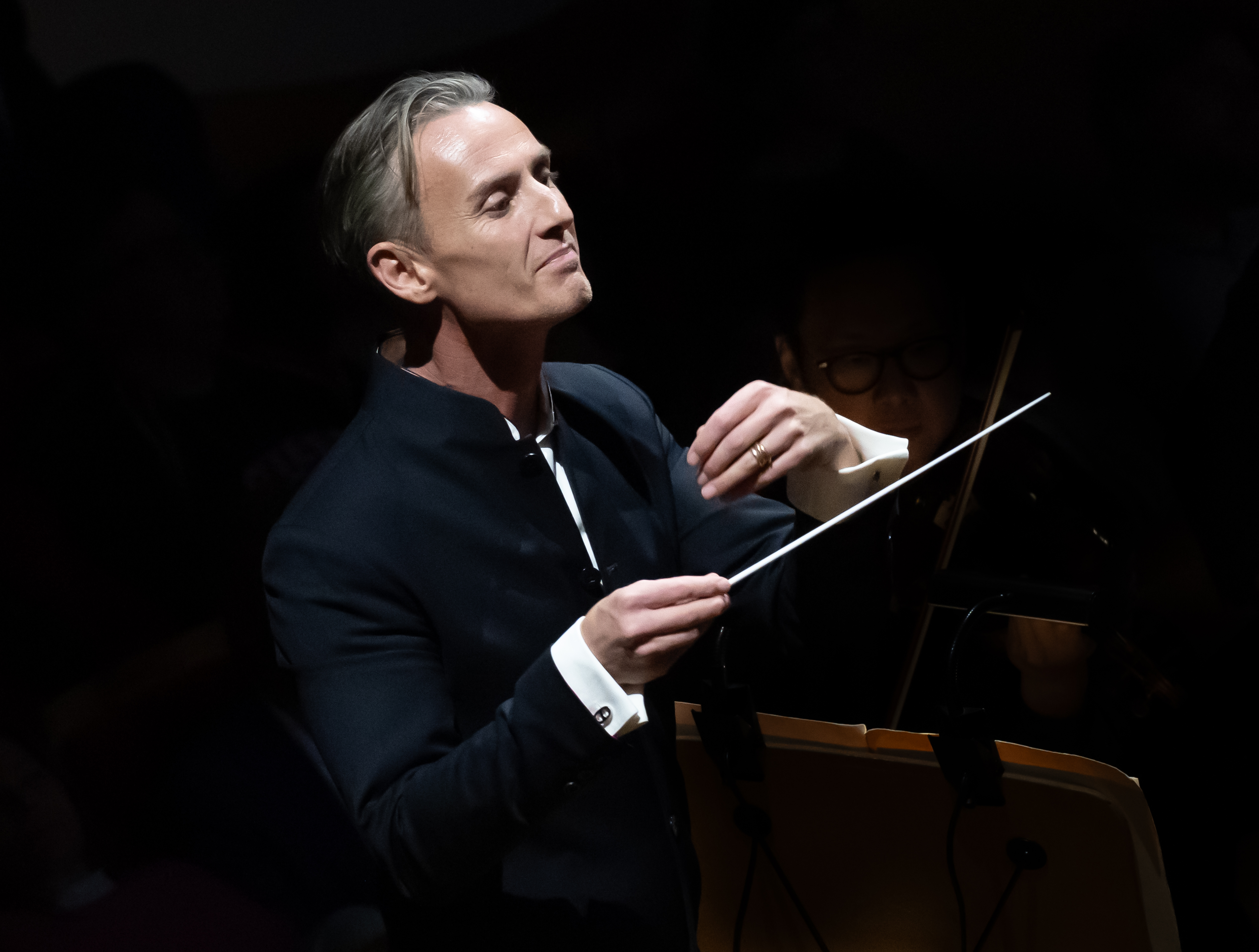
The problems that a symphony orchestra faces when presenting a complete ballet (as opposed to a suite) in concert are many. For the second time in a row, Alexander Shelley, music director designate of the Pacific Symphony, and his orchestra have taken them on. First, it was Ravel’s “Daphnis and Chloe.” Thursday night, in Segerstrom Concert Hall, it was Stravinsky’s complete score to “The Firebird.”
Someone, somewhere, at some point, decided it would be a good idea to present “The Firebird” with animation. It would be projected above the orchestra on a giant screen as the orchestra played the music. The animation would tell the story that the music, without the benefit of dancers, costumes and sets, cannot tell on its own. So far, not a bad idea.
But then, it all depends on the animation that’s created. The Pacific Symphony turned to a local company called Fowler Amusement to do the job. Less than two minutes into the video, give or take, I knew this had been a bad idea.
I’ll spare the reader an extended critique of the video, because just about everything about it was off. On the plus side, the colors were nice, there’s that. It followed the general outlines of the original scenario, too.
But the computer generated images — or however generated — the Pacific Symphony called them “human generated” and specifically warned they were not AI — of the people and creatures in the story had a weird look, a primitive look, as if created, say, in 1999. The eyes had that odd, uncanny look of early computer animation, and Prince Ivan added the strangest set of eyebrows this side of Andy Rooney. Worse still was the way these characters moved, awkwardly, stiltedly, their feet not quite on the ground. Ivan climbed a fortress wall looking like a constipated spider.
What’s more, there was very little dancing in the video, even when Stravinsky supplied lively dance music. An awful lot of staring off into space took its place instead. What dancing there was was stiff, ungainly. You wanted to tell the dancers to relax, but they wouldn’t have heard you anyway.
There’s more, but enough. It didn’t work. I eventually stopped looking at the video, or tried to, as did my guest, but was then faced with the initial problem, that is, listening to a complete ballet, with its many discursions and tangents, in concert, without dancers. The complete “Firebird,” as hinted, doesn’t really work in concert; that’s why Stravinsky made the suites, which do.
Shelley conducted it without score and the orchestra responded gracefully, if not quite as tidily as in previous Shelley collaborations. Some of it seemed a little undercharacterized, skated over, but light is probably better than heavy, here.
The first half of the concert brought the young American violinist Aubree Oliverson to the stage with Korngold’s Violin Concerto. She gave it a charming, well managed reading that didn’t quite plumb its full beauties. Korngold said that he imagined more of a “Caruso” than a “Paganini” for the solo part. This performance needed more Caruso.
Interesting to note, both Oliverson and Shelley, in spoken remarks before the Korngold, failed to mention that the themes in the work were taken from his movie scores. Was this part of the old prejudice against film music?
Oliverson’s entertaining encore was “Menuhin Caprice” by Mark O’Connor, arranged by herself.
Shelley did mention that all of the composers on the program — John Adams, Stravinsky and Korngold — had lived (or live) in California. Trivia: Stravinsky actually lived in Los Angeles longer than any other place in his life, including Russia.
The concert opened with Adams’ “Short Ride in a Fast Machine,” a piece that has made the rounds, of course, but not played here for more than 25 years. Shelley and ensemble gave it the requisite vim, but missed some of its danger. This vehicle was a little too sleek to register the dangerous bumps and turns.
photo: courtesy of Pacific Symphony


 Classical Life
Tim,
We were there last night and you nailed this review! You also made me laugh out loud.
What a half-baked idea.
Hope his new season doesn’t try this again.
Best,
Sherry
Thanks, Sherry!
oh argh! SFS had bad animations for a decidedly mixed Les Noces a couple of years back.
Full disclosure: I wasn’t there. But a knowledgeable and trusted friend who was told me about that animation in exactly the same terms as you have described here. And I fully agree with you about the complete Firebird – unlike the Suite, it does not work well as a concert piece, while the complete Petrushka certainly does much better and complete Le Sacre is in my opinion among the greatest orchestral pieces ever written (in fact, I have not seen – or could even imagine – any balletic version of it that would be worthy of the music).