I listened to my phone messages this morning after a few days away from the office. A reader had called complaining of a headline on one of my reviews in Saturday’s paper. Readers always think that writers write the headlines, but we don’t, at least not usually, in print. So, the caller was all disgusted sounding with me. Acted as if I was a jackass for writing it, and bolstered her argument by quoting me her musical credentials, and those of her husband and daughter, who also thought the headline a blaring mistake.
She read the headline to me in the phone message. I suspected that it might indeed have been a typo or a full-blown blunder. It happens. So I went to the newspaper’s library down the hall and had a look at the headline in Saturday’s edition myself.
What was it? “Pacific Symphony offers ‘Pictures’ at an exposition.” Yes, “exposition.” Note the punctuation.
A writer can’t hope for a much better headline than that — a pun that perfectly captures the gist of my review. I thanked the copy editor responsible for it when I saw it.
Anyway, I called the reader back, and attempted to explain the headline to her, but she was still having none of it. She said puns were supposed to be funny. Really?
Some readers are just a pain. You can’t let it get to you.


 Classical Life
She is probably defensive because she wasn’t quick enough to catch the pun in the first place.
But you can’t please ’em all, anyway.
The meat of a review is the review, itself. Obviously. So I am surprised anyone would read a whole review, then bother to call up to complain about a headline (unless it was just a minor “FYI” message stating the person believed there was a mistake you might want to know about). Since this reader was hostile upfront, she left herself no room to back down when it was shown the mistake was all hers.
“Miss Latella? It’s “violence” on television. “Violence.” Not “violins.”
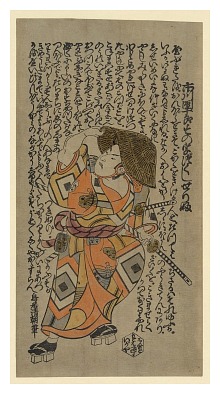
P.S. According to a description on the Library of Congress web site, the print that accompanies my squib, from the 18th century, “shows one of the Soga brothers, Goro (Tokimune), dressed as a warrior surrounded by text containing puns.” He doesn’t appear to be enjoying it.
Fantastic choice of art!
In art, as in politics, it always helps to count to ten before reacting. A well considered answer is better than one off the cuff. But these days people seldom do count in either subject, and this is the result.
I am sure your reader will see this point down the road. At least she’s tuned in.
That;s funny. When I read the review on-line there was no such headline, though I still wouldn’t have taken issue with in any case. Moreover, I concur with MM above that “the meat of the review is the review itself”, which (as always) was splendidly spot on.
By the way, in particular I derived great pleasure from the opening sentence in that review: “Segerstrom Concert Hall became a classroom Thursday evening, conductor Carl St.Clair presiding as professor-in-tails. The course was Introduction to Classical Music 101″.
That astute observation brought a big smile of recognition and prompted me to to blurt out loud (to no one but myself) ” Guess I’m not the only one who felt lectured to”
Not that it pertains to the subject at hand, but If professor St.Clair continues to use these concerts to pontificate about the deeper meaning behind selected pieces, yours truly may finally abandon the PSO (after 18 consecutive seasons) for the OC Philharmonic Series. Guess it’s just me… but classical music lectures disguised as concerts are beggining to do for me what headlines with puns apprently do for a certain disgruntled reader of yours. But rest assured I’ll never blame either situation on you!
Bob, the online headline was written by me. Online headlines are a bit of a different animal than print headlines. Generally, they have to be more straightforward and literal, because a reader can only see the headline when he is deciding if he wants to read something.
In print, of course, the article is laid out right in front of him. In fact, the print version of the review we’re discussing had a giant (and I mean giant) photo of St.Clair and the orchestra taken at the concert right above it. In color too.
The other day I was talking with my 26 year old daughter about how narrow some people can get over time by ignoring the larger perspective in life. A job becomes the measure of ones’s value and purpose, one political issue becomes the entire point of voting in a general election, family and/or work gossip replaces reading a book as a means of self edification, etc. This is another example of absurd myopia sitting in lieu of common sense; someone who considers the punctuation of a headline the principal value of a thoughtful article on a musical masterpiece. I would remind the reader in question of another well known headline of sorts; “A mind is a terrible thing to waste”.
Bill, To be fair to the reader (well, sort of), she didn’t mention or even notice the punctuation. It would have given her a clue that the headline writer hadn’t made a mistake. I pointed out the punctuation to her, but she still scoffed.
But you’re right, she didn’t talk about the article, except to read the part where I mention my background (humorously) — she read it as if to say, “If you’re so well educated, why did you write that dumb-ass headline.”
Anyway, I’m used to it, and not bothered by it. I wrote about it here because I thought it was kind of interesting, and to illustrate what critics have to put up with.