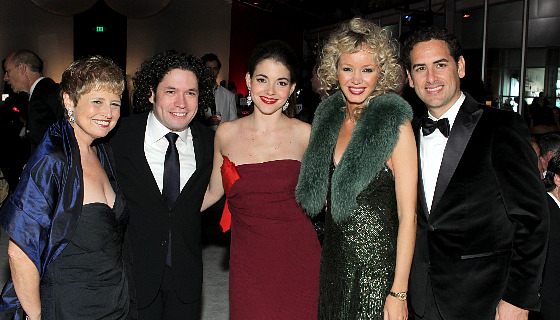
Review: The gala concert is highlighted by a star turn from Juan Diego Florez. The Orange County Register, October 8, 2010. Click here to read my review
Photo: Mathew Imaging
Review: The gala concert is highlighted by a star turn from Juan Diego Florez. The Orange County Register, October 8, 2010. Click here to read my review
Photo: Mathew Imaging
October 8, 2010
Comments RSS and TrackBack URI
This site uses Akismet to reduce spam. Learn how your comment data is processed.



 Classical Life
What, no love for the foody, fashionista, or celebrity maven? You have so much experience now . . .
Truth be told, I’m thrilled that the OCR let you review this concert. Hope we get to read your thoughts on this weekend’s concerts and Turangalila next week as well.
Just looked at the pictures from the evening on the OCR website . . . you didn’t mention that the strings seating had changed.
Reviewing this weekend’s Dudamel concerts, or next weekend’s, is not looking like it’s in the cards. It’s nice to be wanted though.
I’m pleased this concert is available on NPR.org. It’s interesting how the performance seemed to go by so quickly. Moreover, whenever a concert is broadcast from Disney Hall, the unremarkable speakers connected to no less than my computer suddenly sound like they’re of a higher quality. Only problem is such a sound tends to spoil me, as I notice other concerts captured elsewhere aren’t quite as appealing or riveting.
In case anyone wants to watch the concert before it comes out on PBS or DVD, here is a stream from German TV:
http://www.3sat.de/mediathek/mediathek.php?obj=20908&mode=play
Anyone know who’s playing principal horn in the first half? I thought maybe William Vermeulen from Houston, but I’m not sure. Where’s our favorite horn connoisseur, Henry Holland, when you need him . . .
It was William Caballero from the Pittsburgh Symphony.
As always, thank you, MarK. I thought he sounded really nice, especially in the Semiramide Overture.
Seemed in some ways like a very retro weekend overall, most especially for the 2nd Violins, with a familiar face sitting first chair and the whole section moved back over next to the 1sts (FWIW: I’ve amusingly heard my cello friends refer to the new positioning of the strings as “Wrong Seating #1” as opposed to the “Wrong Seating #2” that the orchestra has been in for most of its tenure at WDCH).
.
I have to say, I prefer the seating with the first and second violins together. I know it may not be “historically” correct, but by and large I think the string section just sounds better that way.
Are you sure that strings ALWAYS sound better with seconds seated behind firsts? Did you have a chance to compare the same orchestra playing the same piece with the same conductor in the same hall while seated in different configurations? If you are so sure about violins, then how should violas and cellos be seated? If you believe that one way of seating sounds better than others, then what do you think is the reason that your favorite way is best? Just trying to pick your brain, so to speak…
No, I wouldn’t say that the strings ALWAYS sound better with the violins seated next to each other, just generally. It may be just a personal preference. I’ve noticed with other orchestras, too. I like the overall string sound best when the strings are grouped high to low. I feel there’s more power in the overall string sound and a more homogeneous, satisfying and rich color. And I think this works best — generally — with modern woodwinds, brass and percussion.
One problem with the violins seated left and right, is that it is often hard to hear the crucial second violin parts, as they are pointed away from the audience.
Great discussion . . .
When I was a young lad, I was taught that the normal American seating for strings was (from the conductor’s/audience’s left to right):
Violin 1 – Violin 2 – Viola – Cello/Bass (what my cellist friend now jokingly calls “Right Seating”)
This, I believe, was the LA Phil’s set up for most of their concerts under Mehta, Giulini, Previn, and Salonen while at DCP and even during the first concerts at WDCH.
At some point, Salonen switched the orchestra to the so-called “Wrong Seating #2” (Violin 1 – Cello/Bass – Viola – Violin 2)
I seem to remember reading that the reason for the change was to allow the cellos to project more into the hall by facing forward, while splitting the violin’s “opened up” the orchestra’s sound. I always thought that the opportunities for counterpoint between the two violin sections were fewer than the times they needed to play as more like one unit (I keep thinking of the opening of the last movement of the Tchaikovsky 6th), but I am definitely no expert and was happy to defer to E-P. Cellos & basses did seem to have more presence in this set up, at least from my seat.
Now that the orchestra has been in the so-called “Wrong Seating #1” at the beginning of this season (Violin 1 – Violin 2 – Cello-Bass – Viola), it seems like a good compromise: violins all together, cellos still facing forward.
Tim’s comments about the 2nd violin section pointing away from the audience in WS#2 is true enough, but that applies equally now to the violas in WS#1.
Seating strings “high to low” seems the most natural way – nice visually for the audience and probably most convenient for conductors. However, most of the world’s great orchestras (and many of the best string quartets, for that matter) do not perform that way. Why? There must be a reason. The point about second fiddles facing the other way is accurate but it applies even more so to violas! In fact, violas generally have more “crucial” lines than the seconds, their sound projection is generally weaker, the register is the least advantageous in most acoustical environments, and, finally, there are always fewer violists in the orchestra than second violinists (not to mention the firsts). So, why put violists in such a disproportionally disadvantageous position?
If you ask me, i would put violists where the first fiddles usually are – in the best location on the left. Next to them – seconds, to avoid the facing backward problem. Then cellos, so that they can project into the audience. And finally, on the right, the firsts – they can overcome facing backward better than anyone else because there are always more of them than members of any other instrumental group and because they play in the register that projects most strongly. Or i can propose another solution – high to low but in the opposite direction from the usual way, from firsts on the right to cellos on the left, which would put everyone in a slightly disadvantageous position, but much more equally so than in traditional seatings. Has anyone ever tried either one of these two options anywhere? Probably not. Why? The only reason i can guess would be the disproportionate egos of first violinists.
The opening of the last movement of the Pathetique is precisely the reason why in this piece dividing first and seconds does make sense. When Tchaikovsky was writing it, that was how Russian orchestras were seated and by alternating melodic notes between the two sections he has created a rather unique stereo effect. If he wanted all violins to sound like one section, then why would he orchestrate it that way? He would just give the top voice to the firsts. Actually, i had an opportunity to talk to both Esa-Pekka and Gustavo about that (on separate occasions, of course), and they both agreed with my understanding of that passage.
Yes, for that passage in the Pathetique, you have to have the violins split right and left, or it doesn’t come off the way the composer intended. I imagine that there may be similar things going on in the pizzicato movement of the Fourth Symphony, though I’m not sure.
But of course, there’s far more music in the repertoire where these types of stereo or echo effects aren’t present. Generally, the second violins harmonize with the firsts, or support them in some fashion.
I’m not against other types of seating. But I do like the bass instruments to be grouped together — i.e. the double basses with the trombones and tuba. It, again, gives more presence to the bass sound. It’s less diffuse than when they are stationed apart. Same with the violins — generally. I like the rich sound they produce when placed together, not the diffuse one when placed apart.
That said, some of my favorite conductors — including Klemperer and Monteux — made their recordings with the violins split. But then, those are recordings.
Just re-read what I had originally typed re: Pathetique, and realized that what I meant to say (i.e. what Tim and MarK both said, namely that the last movement of the symphony is an example of when you’d want divided strings) is NOT what I actually typed.
Darn those misplaced parenthetical phrases!!
BTW: Went to the Turangalila concert yesterday, and enjoyed it. Very nice to be back in WDCH.
“One problem with the violins seated left and right, is that it is often hard to hear the crucial second violin parts, as they are pointed away from the audience.”
Just sit behind the orchestra. And continuing big ups to Dudamel for having the orchestra turn around to face us after the last piece in every program.
The Philharmonic should announce who is playing on any given night – maybe in a program insert. So many subs and auditioners it is hard to understand exactly what a performance by ‘the LA Phil’ actually means(*). On Saturday night, in addition to the horn, there was at least one unfamiliar face in the first violins, one or more in the seconds, the flute sub that has been doing great work while they were playing footsy with the yoyo from Chicago, big Armen in the cellos, etc.
(*) Probably true of all orchestras
One of the subs should be familiar to OC audiences: Barry Perkins of the Pacific Symphony was/is filling in for the now retired Boyde Hood in the trumpet section. Larry Kaplan (Hollywood Bowl Orchestra, Southwest Chamber Music) continues to play as 2nd flute.